An Exclusive Distribution Agreement with a Chinese Company is a contract under which one party (the supplier, in this case a Chinese company) agrees to supply goods or services exclusively to a single business within a specified territory. For many businesses, entering into an exclusive arrangement with a Chinese supplier can provide a significant competitive advantage in both local and international markets. Cooperation with Chinese manufacturers offers access to a wide range of products and competitive production costs.
However, legal safeguards are essential to minimise potential risks. Before signing an Exclusive Distribution Agreement, it is advisable to conduct a Chinese Company Verification and confirm that the Chinese company genuinely holds the rights to the products in question and is legally entitled to grant exclusivity for their distribution or sale. To ensure that the agreement is effective and does not expose the business to unnecessary risks, several key issues should be carefully considered.
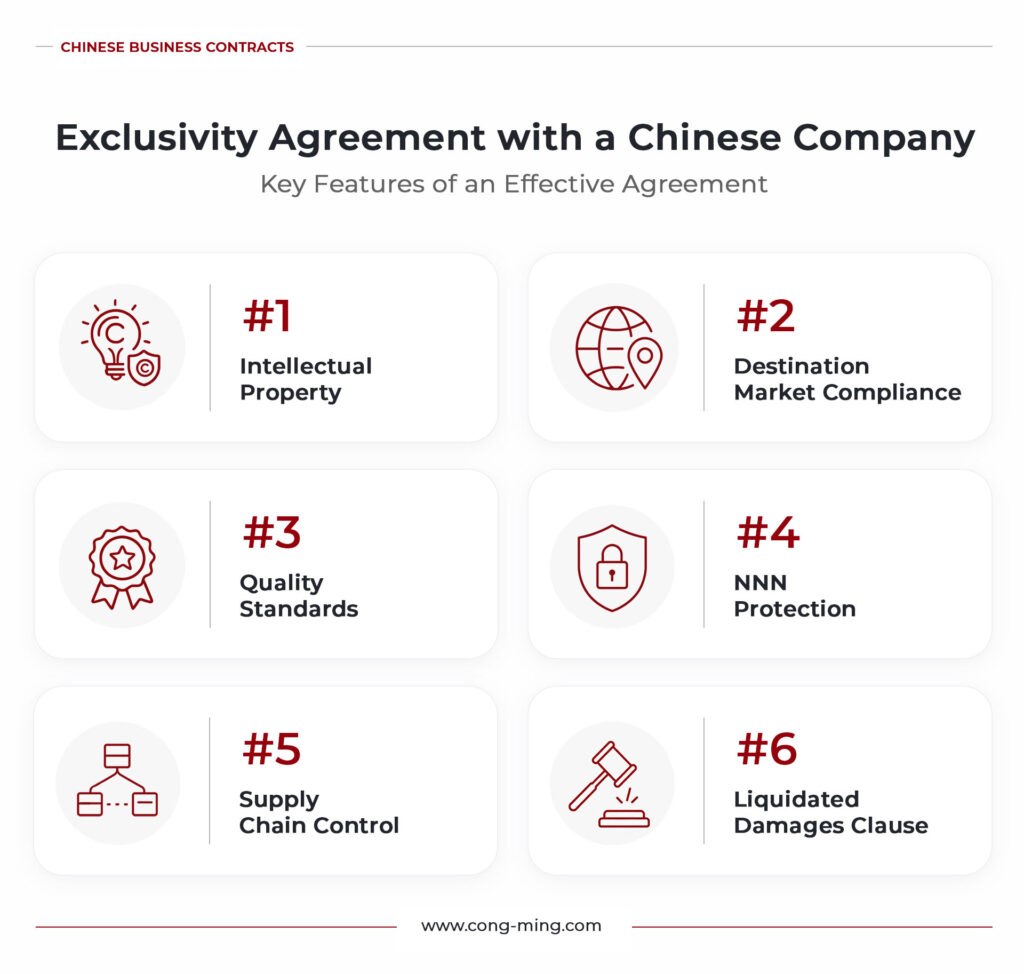
In this article, we explain what to consider when negotiating an Exclusive Distribution Agreement with a Chinese factory. We also discuss the key provisions that should be included in such a contract to provide stability, legal protection, and long-term commercial security.
Intellectual Property Protection in an Agreement with a Chinese Supplier
One of the most important aspects of an Exclusive Distribution Agreement with a Chinese supplier is the protection of intellectual property rights. In the context of international trade, intellectual property may include patents, industrial designs, trademarks, copyrights, and other proprietary rights. When negotiating exclusivity, it is particularly important to determine who owns the intellectual property associated with the products covered by the agreement.
Key questions include:
- Will your company own the trademarks, industrial designs, and patents related to the products?
- Is the Chinese supplier granting only a licence to use the intellectual property, or transferring full ownership rights?
Transfer of Intellectual Property Rights
Before signing the agreement, it is essential to determine whether the Chinese supplier is transferring intellectual property rights to your company or merely granting a limited licence to use them. A transfer of ownership means that your company becomes the legal owner of the intellectual property. This provides significantly greater control over the product, its branding, and its future distribution.
Territorial Nature of Intellectual Property Rights
The territorial nature of intellectual property protection is another critical issue. Intellectual property rights are generally protected on a country-by-country basis. This means that rights registered in China are not automatically protected within the European Union or individual EU member states. For this reason, businesses should ensure that relevant intellectual property rights are also registered within the European Union where appropriate. This may include trademarks, patents, industrial designs, or copyrights. Without proper protection in the target market, products may be vulnerable to infringement by competitors, potentially resulting in substantial financial losses.
Free Movement of Goods in the EU and Exclusive Distribution Agreements
The European Economic Area (EEA) is a free trade zone comprising the Member States of the European Union as well as several EFTA countries. The principle of the free movement of goods within the EEA can present significant challenges for businesses that have entered into an Exclusive Distribution Agreement with a Chinese supplier, particularly where their operations are focused on a single market, such as Germany, France or Poland.
For example, if your exclusivity applies only to Poland, another company may legally import the same products into Germany or France and subsequently sell them in Poland. In practice, this can significantly reduce the value of your exclusivity arrangement and allow competitors to offer identical products at lower prices.
To reduce this risk, the agreement should contain provisions restricting unauthorized redistribution of products within the EEA. Businesses may also consider negotiating broader territorial exclusivity covering multiple European markets. Another important protective measure is registering trademarks and product designs with the European Union Intellectual Property Office (EUIPO), which can strengthen enforcement options against infringing parties.
NNN Agreements – Essential Protection Against Abuse
Cooperation with Chinese suppliers often requires the exchange of sensitive business information, including technical specifications, marketing strategies, customer information, and sales plans. For this reason, it is highly advisable to sign an NNN Agreement (Non-Use, Non-Disclosure, Non-Circumvention) before disclosing confidential information. An NNN Agreement protects your business on three levels. It prevents unauthorized disclosure of confidential information, restricts the supplier from competing directly with your company, and prevents the supplier from bypassing your business by dealing directly with your customers.
Supply Chain Management in an Agreement with a Chinese Factory
Another important aspect of an Exclusive Distribution Agreement with a Chinese supplier is supply chain management. The agreement should clearly define delivery schedules, payment terms, and responsibility for product quality. It should also address potential delays resulting from international transportation, customs clearance procedures, and other factors that may affect delivery times. Businesses should consider including provisions requiring the supplier to maintain minimum safety stock levels. Such measures can help reduce the risk of inventory shortages in the event of unexpected production or logistics disruptions.
The agreement should also grant the buyer the right to conduct quality inspections at the manufacturing facility. Additional inspections upon arrival of the goods in the destination country may also be appropriate. In the event that products are found to be defective or fail to comply with agreed specifications, the agreement should establish clear claims procedures and define the supplier’s obligations. It should also provide for contractual penalties where products do not meet the agreed quality requirements.
Product Quality and Safety Responsibilities
Products placed on the European Union market must comply with strict quality and safety requirements. For this reason, an agreement with a Chinese manufacturer should include provisions requiring the supplier to deliver products that comply with all applicable EU regulations and standards. When working with a Chinese supplier, responsibility for product compliance is often shared between the manufacturer and the importer. As a result, it is essential to clearly allocate responsibilities and establish appropriate compliance procedures.
To ensure that products meet all applicable requirements, businesses should reserve the right to conduct regular audits and quality inspections at the supplier’s facilities. Such measures may include on-site inspections, laboratory testing, pre-shipment inspections, and reviews of technical documentation.
The agreement may also require the supplier to provide certificates, test reports, declarations of conformity, and other documents demonstrating compliance with European regulations. These measures significantly reduce the risk of importing non-compliant products and help protect the importer from potential regulatory and financial consequences.
Penalties for Breach of an Exclusive Distribution Agreement
Every Exclusive Distribution Agreement with a Chinese company should clearly define the consequences of any breach of its provisions. Contractual penalties, damages and termination rights in the event of serious violations are essential safeguards that help protect the distributor’s commercial interests. Breaches of the agreement may take many forms, including delays in delivery, the supply of products that do not conform to the agreed specifications, violations of confidentiality obligations or breaches of non-compete provisions.
Before entering into an Exclusive Distribution Agreement, it is also advisable to review the supplier’s litigation history and legal background as part of a PRO Chinese Company Verification Report. This can help identify potential risks and provide a better understanding of the company’s business practices. The agreement itself should clearly specify which actions will constitute a breach of contract and what legal or financial consequences will follow from such violations.
Summary
Entering into an Exclusive Distribution Agreement with a Chinese supplier is a strategic decision that can provide significant commercial advantages. However, it also requires careful planning and consideration of a range of legal and practical issues. Particular attention should be paid to the protection of intellectual property rights, the risks associated with the free movement of goods within the EEA, and the clear allocation of responsibility for product quality and regulatory compliance. A properly structured agreement that addresses NNN protections, supply chain management and the consequences of contractual breaches provides a solid foundation for minimising risks and maximising the benefits of long-term international cooperation.


Exclusive Distribution Agreement with a Chinese Supplier
Would you like to gain a competitive advantage through exclusive rights to distribute products sourced from China? A professionally drafted Exclusive Distribution Agreement can provide greater stability, strengthen your market position, and protect your business from unfair competition and commercial risks.
Contact us today to learn how to effectively structure and negotiate an Exclusive Distribution Agreement with a Chinese supplier.

