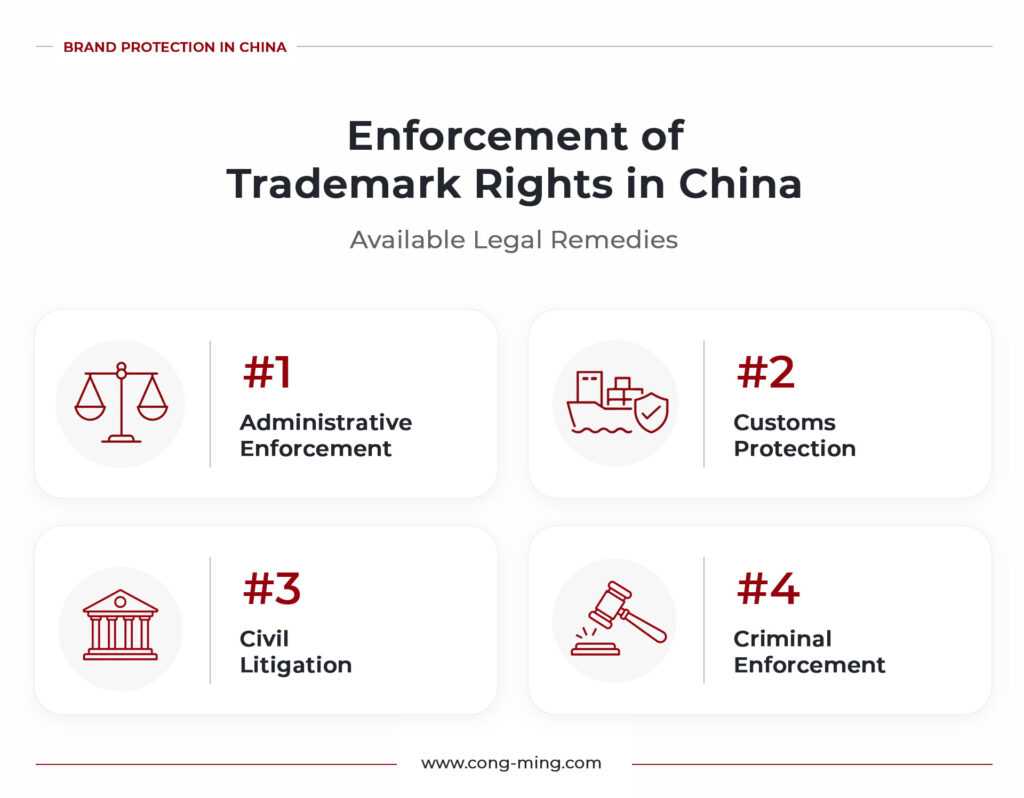
Trademark enforcement in China becomes more effective with each passing year. Under the Chinese legal system, trademark rights may be enforced through civil litigation, administrative enforcement procedures, and criminal proceedings. Administrative enforcement mechanisms also allow trademark owners to benefit from customs border protection measures. Before discussing the available enforcement options, it is important to understand which activities are considered trademark infringements under Chinese law.
Trademark infringement may arise both in relation to registered trademarks and, in certain circumstances, in relation to trademarks that have not yet been formally registered with the China National Intellectual Property Administration (CNIPA).
Infringement of a Registered Trademark
The Trademark Law of the People’s Republic of China identifies several categories of infringement involving registered trademarks.
Counterfeit Goods
The unauthorized manufacture, storage, or sale of counterfeit goods bearing a trademark identical to a registered trademark constitutes trademark infringement in China. The sale of counterfeit products is also considered an infringement, regardless of whether the seller attempts to deceive customers or openly acknowledges that the goods are counterfeit.
In the first scenario, consumers are intentionally misled. In the second, consumers knowingly purchase counterfeit goods. However, in both cases, the seller harms the interests of the trademark owner and derives an unjustified commercial benefit from the use of the protected trademark.
Use of an Identical or Similar Sign
Trademark infringement may also occur where a sign identical or similar to a registered trademark is used in connection with goods covered by the trademark registration. The greater the similarity between the signs and the greater the likelihood of consumer confusion, the higher the risk that the conduct will be considered infringing. In such cases, the trademark owner may seek to prohibit the use of the conflicting sign. However, the trademark owner must demonstrate that a likelihood of confusion exists among the relevant consumers.
Manufacture or Sale of Trademark Labels
Even where trademark labels have not yet been attached to products, their unauthorized manufacture or sale may constitute trademark infringement. The production of counterfeit labels is often an essential step in the manufacture of counterfeit goods. Such activities frequently occur alongside legitimate production orders.
For example, a supplier engaged to print labels for an authorized production run may possess the original artwork and production materials. The supplier may then unlawfully manufacture additional labels and sell them through unauthorized channels.
Trademark Substitution
Removing a genuine trademark from a product without the trademark owner’s consent, replacing it with another trademark, and subsequently placing the product on the market constitutes trademark infringement under Chinese law.
Aiding and Abetting Trademark Infringement
This category primarily relates to activities that assist others in infringing trademark rights, including the storage, transportation, shipment, or concealment of infringing goods. Chinese trademark authorities interpret this category broadly, and it may also apply where infringement occurs at trade fairs, in physical retail stores, or on online marketplaces. In such circumstances, exhibition organizers, commercial landlords, and online platform operators may also be held liable if they facilitate or knowingly enable trademark infringement.
Other Acts Causing Harm to Trademark Rights
This category includes three common types of trademark infringement. The first involves the use of a sign identical or similar to a protected trademark as a trade name. This will constitute infringement where two conditions are met. First, the sign is used in relation to the same or similar goods as those covered by the trademark registration. Second, the use of the sign is likely to mislead the relevant consumers.
Another form of infringement involves the use of a sign that reproduces, imitates, or translates a previously registered well-known trademark. In addition, registering a domain name and using it to sell products may constitute infringement where the domain name is identical or similar to a protected trademark and is likely to mislead the relevant public.
Other Types of Trademark Infringement
Chinese trademark law also recognizes several additional forms of infringement. These include the free distribution of goods bearing a protected trademark, for example as gifts, promotional items, or bonus products. In addition, a licensee that continues to sell goods manufactured after the termination of a trademark licence agreement may also be liable for trademark infringement.
Infringement of an Unregistered Trademark
Under certain circumstances, Chinese trademark law provides protection for trademarks that have not yet been registered with the China National Intellectual Property Administration (CNIPA). Such protection is most commonly granted where a trademark has been registered in bad faith by a party that was not entitled to do so. As a result of such a registration, the legitimate owner of the brand may lose all rights to the trademark in China.
Unfortunately, this remains a common problem faced by foreign businesses attempting to enter the Chinese market. More information about the loss of trademark rights in China resulting from bad-faith registrations can be found in a separate article.
Practical Trademark Enforcement in China
In administrative proceedings, any person may file a complaint regarding trademark infringement with the authority having jurisdiction over the place where the infringement occurred. The local Market Regulation Administration may order the infringer to cease the infringing activities, confiscate and destroy infringing goods, and impose administrative fines. However, administrative authorities do not have the power to award compensation for damages suffered by the trademark owner.
Customs authorities may also take action by carrying out border inspections of imported or exported goods suspected of infringing trademark rights. Such measures may result in the suspension of imports or exports and the destruction of infringing goods.
In China, civil trademark infringement actions may be brought before any court having jurisdiction over the place where the infringement occurred. Proceedings may also be initiated before the court having jurisdiction over the defendant’s place of business. China has established three specialized intellectual property courts located in Beijing, Shanghai, and Guangzhou. However, trademark disputes are generally heard by the ordinary People’s Courts. These courts may order the infringer to cease the infringement, confiscate and destroy infringing goods, and award damages to the trademark owner. In urgent cases, a preliminary injunction may also be obtained before full court proceedings begin.
Certain trademark infringements are considered criminal offences under Chinese law. In serious cases involving the sale of counterfeit goods, criminal proceedings are often the only effective way to stop the infringing activities. Initiating criminal proceedings requires a complaint to be filed with the public prosecutor. Such proceedings may result in searches without prior notice, as well as imprisonment and criminal fines for the persons responsible.
Summary
Trademarks play a vital role in building and maintaining the reputation of every brand. Unauthorized or improper use of a trademark can have serious commercial consequences. For this reason, taking appropriate action, enforcing trademark rights in China, and stopping infringements should be a priority for every trademark owner.
Following recent reforms to Chinese trademark law, trademark enforcement has become increasingly effective. Trademark owners may pursue their rights through administrative, civil, and criminal procedures. Moreover, in certain circumstances, Chinese law provides protection for trademarks even where the infringement occurred before the trademark was formally registered. These provisions generally apply where a prior registration was obtained in bad faith.


Trademark Enforcement in China
Do not risk losing control over your brand or allowing infringements of your intellectual property rights to go unchallenged. Entrust the enforcement of your trademark rights in China to experienced professionals and ensure that your interests are properly protected and infringing activities are effectively stopped.
Contact us today to protect your brand in China and conduct business with confidence.

