Importing products from China has become an essential part of the business strategy of many European companies. This is particularly true in the era of e-commerce, where platforms such as Alibaba and Made-in-China have made access to Chinese suppliers easier than ever before.
Many importers assume that B2B marketplaces provide sufficient protection and make importing from China a simple and risk-free process. Unfortunately, this approach can lead to serious problems if proper safeguards are not put in place before placing an order. One of the most important protective measures is a professionally drafted sales contract signed with the Chinese supplier.
Regardless of whether products are purchased through online B2B platforms or directly from a manufacturer, every order should be properly secured. One of the key tools for minimizing risks in China sourcing is a sales contract signed with the Chinese supplier.
In the context of the global economy, cooperation with Chinese companies requires a solid legal framework that allows previously agreed terms to be effectively enforced. The key tools in this regard include conducting a Chinese Company Verification before deciding to enter into a business relationship, putting in place a NNN Agreement with a Chinese Business Partner before sharing confidential information, signing a Sales Contract with a Chinese Supplier before placing an order, and carrying out a quality inspection before making the final payment for the goods. The bilingual English-Chinese sales contract plays a particularly important role in this process, providing clarity, legal protection and reducing the risks associated with international transactions.
Why Is a Sales Contract with a Chinese Supplier So Important?
Signing a contract with a Chinese supplier is one of the most effective ways to protect the interests of the importer. Whether you are just starting a business based on importing from China or have years of sourcing experience, every order should be supported by a properly drafted agreement. A comprehensive contract does far more than simply provide legal protection. It ensures that both parties fully understand their obligations and expectations. It can also protect intellectual property and increase the importer’s priority compared to buyers who do not have a formal agreement in place.
#1
Precise Terms and Reduced Risk of Misunderstandings
A sales contract allows all transaction terms and product requirements to be clearly defined. Unlike communication based solely on emails or instant messages, a contract provides a structured document where all critical aspects of the transaction can be reviewed and confirmed. This significantly reduces the risk of overlooking important details, which almost always works against the buyer.
In addition, a contract prepared in Chinese is much easier for the supplier to understand. This helps ensure that product specifications and requirements are interpreted correctly. One common issue in negotiations with Chinese suppliers is that they may agree to requests simply to maintain a positive business relationship, even when they do not fully understand the requirements or disagree with them. In some cases, misunderstandings are later attributed to translation issues. A bilingual English-Chinese sales contract helps eliminate these risks and creates a clear reference point for both parties.
#2
Order Priority and Financial Protection
China is the world’s manufacturing hub, and Chinese suppliers sell their products to companies from all over the globe. A contract that clearly defines the obligations of both parties and establishes penalties for breaches of contract can provide a significant advantage over other foreign buyers.
In practice, Chinese companies are generally more inclined to honor their obligations towards customers with whom they have signed clear and enforceable agreements than towards those who rely solely on emails, purchase orders, or informal arrangements. For this reason, signing a sales contract increases the likelihood that your order will receive higher priority within the supplier’s production schedule.
This is particularly important during peak production periods or when raw materials are in short supply. A well-drafted contract can also include penalties for delays, creating an additional incentive for the supplier to complete the order on time.
#3
Contract Enforcement and Legal Protection
A professionally drafted sales contract provides a strong legal foundation in the event of a dispute. China’s legal system offers effective mechanisms for resolving commercial disputes, including specialized commercial courts and online courts. These institutions are widely used by international businesses and are recognized for their professionalism and efficiency. Moreover, Chinese companies generally take legal obligations seriously when those obligations can be enforced under Chinese law. As a result, the possibility of legal proceedings or arbitration significantly strengthens the negotiating position of the foreign buyer.
A properly drafted contract therefore serves as a powerful incentive for the supplier to fulfill its obligations. By signing a legally enforceable agreement, the supplier becomes fully aware of the potential consequences of non-compliance. Knowing that the contract can be enforced in China, Chinese companies are generally more motivated to meet agreed deadlines, quality standards, and other contractual commitments.
The situation is very different when no contract is signed or when the agreement has been prepared without considering Chinese law. In such cases, the supplier may feel that the buyer has limited legal options and therefore face little pressure to comply with the agreed terms. For this reason, a sales contract should ideally be prepared by a lawyer familiar with Chinese law and commercial practice. A professionally drafted English-Chinese contract can become a key piece of evidence in any legal action taken in China.
#4
Product Compliance and Safety
In the past, the prices of Chinese products were often so competitive that importers could absorb losses resulting from quality issues, delivery delays, or non-compliance with applicable standards while still maintaining healthy profit margins. Today’s business environment is very different. Companies placing products on the European market cannot afford such compromises.
Numerous EU directives and regulations impose strict safety, quality, and compliance requirements on a wide range of products. Importers are also bound by local laws and contractual obligations towards their customers, requiring them to deliver products of a specified quality within agreed timeframes. As a result, European importers must ensure that their Chinese suppliers comply with the same standards and requirements that apply to them. A sales contract with a Chinese supplier clearly defines product requirements and provides an effective mechanism for enforcing them.
What Should a Sales Contract with a Chinese Supplier Include?
When preparing a sales contract with a Chinese supplier, it is essential that the agreement is clear, enforceable, and compliant with Chinese law. The contract should be bilingual, drafted in both Chinese and English. It should also be prepared by a lawyer familiar with Chinese law to ensure that its provisions can be effectively enforced in China. Clearly defined transaction terms, together with a thorough analysis of the product and production process, form the foundation of successful cooperation with a Chinese supplier. A sales contract with a Chinese supplier should include, among other things:
- Identification details of the buyer and seller
- Bank account information
- Product type and quantity
- Unit price and total contract value, including the applicable currency
- Payment terms
- Delivery schedule
- Delivery terms (Incoterms)
- Technical product specifications
- Packaging requirements
- Clearly defined quality standards
- Quality control procedures
- Contractual penalties
- Insurance provisions
- Warranty terms
- Arbitration clauses
It should be noted that the considerations outlined above primarily relate to the purchase of finished products from Chinese suppliers. Where goods are manufactured according to the buyer’s own specifications or sold under a private label, the scope of legal and commercial protections required is considerably broader. More information on this topic can be found in our article on a Manufacturing Agreement with a Chinese Factory.
Key Features of a Sales Contract with a Chinese Supplier
Preparing a sales contract with a Chinese supplier requires particular attention to compliance with Chinese law. It is essential to address issues relating to the choice of governing law and jurisdiction, as well as the proper structure of contractual penalties. Equally important is the inclusion of arbitration clauses that adequately protect the interests of the importer. The contract should be prepared in both Chinese and English in order to avoid misunderstandings and ensure that both parties fully understand their obligations. This approach significantly increases the likelihood of successful enforcement while reducing the risks commonly associated with international trade.
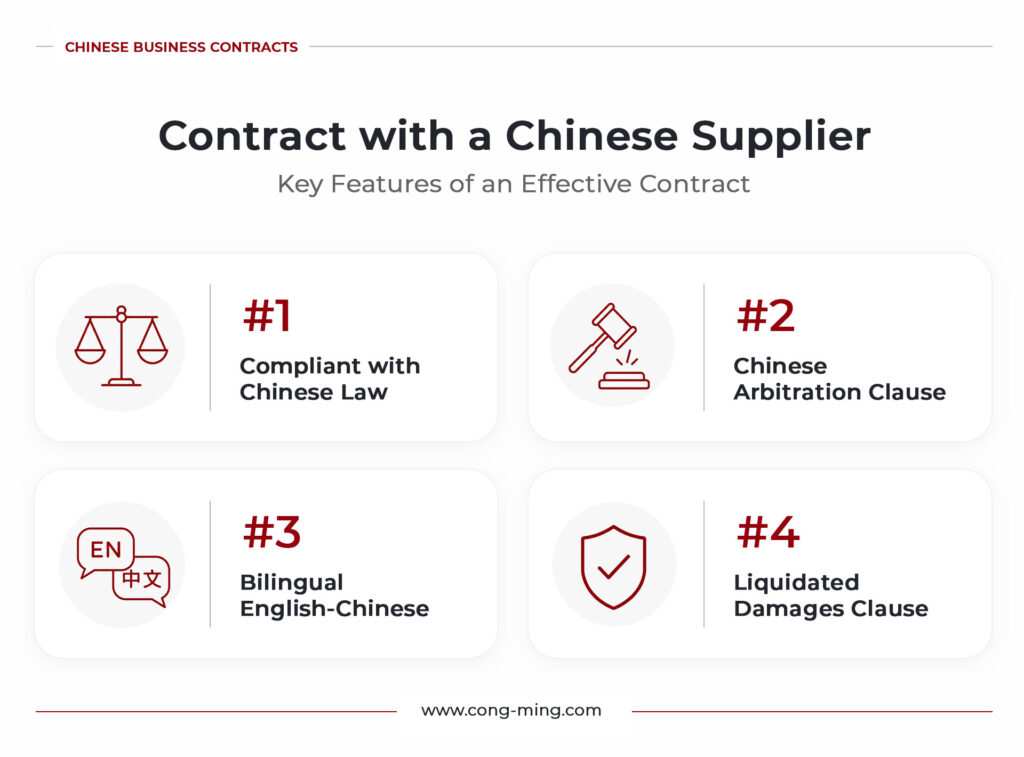
Compliance with Chinese Law
Under Chinese civil law, Chinese companies and their foreign counterparts are generally free to choose the governing law and dispute resolution mechanism applicable to their contracts. However, it is important to understand that courts outside China have no authority to enforce judgments directly against Chinese companies within China.
Only Chinese courts and Chinese arbitration institutions can effectively enforce decisions against Chinese entities and their assets located in China. For this reason, it is usually in the importer’s best interest to ensure that the contract is drafted in a manner that complies with Chinese law. The agreement should satisfy all applicable legal requirements and include an arbitration clause that meets the formal standards recognized in China.
It is also important to remember that a contract may be deemed unenforceable or invalid if it conflicts with mandatory provisions of Chinese law. This is why a sales contract should be carefully prepared by a lawyer experienced in Chinese commercial law.
Chinese Arbitration
When entering into a sales contract with a Chinese supplier, protecting the buyer’s interests and establishing consequences for contractual breaches are essential. In order to effectively enforce those provisions, the agreement should designate a Chinese arbitration institution to resolve potential disputes.
An arbitration tribunal can determine whether contractual penalties are valid and may issue an enforceable award against the Chinese company. It is generally advisable to select a reputable arbitration institution such as CIETAC (China International Economic and Trade Arbitration Commission) or BAC (Beijing Arbitration Commission), both of which have extensive experience handling international commercial disputes. Beijing and Shanghai are often preferred as arbitration venues due to the high level of expertise available among local arbitrators. It is also common practice to appoint at least one arbitrator who is not a Chinese national, a solution that many Chinese companies readily accept.
The contract should further specify that arbitration proceedings will be conducted in English. If the language is not expressly stated, the proceedings will typically be conducted in Chinese, which may place the foreign buyer at a significant disadvantage.
Bilingual English-Chinese Contract
Successful cooperation with Chinese companies requires comprehensive documentation. For this reason, it is highly advisable for contracts to be prepared in Chinese. Since most foreign business owners do not speak Chinese, the most practical solution is to prepare a bilingual contract in both Chinese and English. Such an agreement should clearly specify which language version will prevail in the event of discrepancies or disputes.
If a dispute is likely to be resolved before a Chinese court or arbitration tribunal, having a Chinese-language version is particularly important. Chinese courts rely on their own translators, and official translations may not always fully reflect the intentions of the parties. For this reason, it is often preferable to have the contract translated and reviewed by your own legal advisors before signing. This ensures a clear understanding of the agreement and reduces the risk of unintended interpretations.
Another major advantage of a Chinese-language contract is the clarity it provides for the supplier. Many disputes between foreign buyers and Chinese suppliers arise not because of bad faith, but because the parties interpret contractual terms differently. Providing the supplier with a carefully drafted Chinese-language agreement helps prevent such misunderstandings and creates a clear framework for cooperation.
Contractual penalties
A sales contract with a Chinese supplier should clearly define contractual penalties for potential breaches of the agreement. If, as an importer, you face penalties for delayed deliveries, it is entirely reasonable to require the supplier to bear responsibility for delays on its side as well.
Chinese law recognizes contractual damages provisions, allowing the parties to agree in advance on compensation payable in the event of a breach. However, Chinese courts and arbitration tribunals may adjust the final amount of compensation based on the actual losses suffered by the injured party.
For example, if the products delivered by the supplier fail to meet the agreed specifications, the importer may seek compensation for losses resulting from that non-compliance, including lost profits where appropriate.
Determining the correct level of contractual damages is extremely important. If the amount is too low, it may not adequately compensate the importer for actual losses. Conversely, if the amount is excessive, it may be challenged and reduced by a court or arbitration tribunal.
Summary
Working with Chinese suppliers requires a well-structured and carefully drafted sales contract. An agreement prepared by a lawyer familiar with Chinese law helps ensure compliance with local regulations while providing adequate protection for the importer’s interests. A bilingual English-Chinese contract also allows claims to be enforced more effectively if the supplier fails to meet its contractual obligations.
Moreover, a professionally drafted contract is more than just a legal safeguard for the transaction. It is also an effective tool for minimizing risks arising from cultural and language differences. Most problems encountered when working with Chinese companies are not caused by bad faith, but rather by communication challenges and misunderstandings.
A sales contract that complies with Chinese law encourages the Chinese supplier to fulfil its obligations diligently. Knowing that the agreement can be enforced in China, the supplier is more likely to comply with the agreed terms in order to avoid legal disputes and reputational damage. The inclusion of well-drafted arbitration clauses and clearly defined contractual penalties further strengthens the importer’s negotiating position and increases confidence that the order will be completed as agreed.

Sales Contract with a Chinese Supplier
Do not risk quality issues, delivery delays, or unnecessary disputes with your Chinese supplier. Invest in a professionally drafted sales contract and ensure that your transactions are properly secured and your business interests effectively protected.
Contact us today to safeguard your orders and enjoy smooth, reliable cooperation with Chinese suppliers.

