Working with Chinese factories is an attractive option for many European businesses. It offers significant opportunities to increase profits, but without proper preparation, companies may expose themselves to substantial risks and financial losses.
As the world’s manufacturing hub, China provides competitive pricing and access to a vast range of products. However, businesses outsourcing production to China often make mistakes that can lead to serious complications. One of the most common issues is the absence of a properly drafted manufacturing agreement, which increases the risk of product defects, non-compliance with specifications, delivery delays, and other costly problems.
Signing an appropriate agreement is the foundation of a secure business relationship with a Chinese manufacturer. It is far more than a formality. A well-drafted contract protects product quality, delivery schedules, and intellectual property while reducing the risk of unfair business practices. To ensure that every transaction with a Chinese factory is properly secured, it is important to understand how to avoid the most common mistakes.
The basic principles of sales contracts with Chinese suppliers are discussed in a separate article. In this guide, we explain why a manufacturing agreement with a Chinese factory is essential, how to prepare a contract that genuinely protects the buyer’s interests, and which contractual penalties should be included to safeguard your business.
What Mistakes Do Importers Most Commonly Make?
Cooperating with Chinese factories is an attractive option for many businesses. However, not all importers ensure that a proper Manufacturing Agreement with a Chinese Factory is put in place from the outset. This can lead to serious problems later in the cooperation. It is therefore worth understanding why this happens and what the most common mistakes made by importers are in this regard.
- Lack of Understanding of the Importance of a Manufacturing Agreement
The first and most common reason businesses fail to sign a contract is a lack of understanding of its importance. Many importers do not realize that a manufacturing agreement with a Chinese factory forms the foundation of a secure transaction. Such an agreement not only regulates delivery schedules, payment terms, and product quality requirements, but also establishes procedures for resolving disputes should problems arise. - Reluctance to Incur Additional Costs
Another common mistake is avoiding the cost of preparing a professional contract. Many business owners believe they are saving money by not engaging legal professionals. In reality, the absence of a properly drafted agreement often results in far greater costs if problems occur during production or delivery. - Excessive Trust in the Chinese Factory
Overconfidence in a Chinese supplier can also create significant risks. Importers who have worked with the same factory for an extended period sometimes feel comfortable enough to rely solely on informal arrangements. Unfortunately, this can leave them without an effective mechanism for enforcing agreed terms if issues arise. - Rushing to Place an Order and Pay the Deposit
One of the most common mistakes occurs when businesses move too quickly. In an effort to secure production and place an order as soon as possible, importers often pay a deposit before signing a manufacturing agreement. This can create serious problems. Once the factory receives payment, it may recognize that the buyer has not taken the necessary steps to protect its interests. In some cases, factories may prioritize customers with stronger contractual protections or attempt to supply products that were previously rejected by another client during quality inspections. Without a properly drafted manufacturing agreement, enforcing delivery terms, quality requirements, and other contractual obligations becomes significantly more difficult.
Common Misconceptions
- The Misconception That An Invoice Is Sufficient Protection
Many businesses mistakenly believe that an invoice is sufficient to protect their interests when manufacturing products in China. While an invoice is an important accounting document, it cannot replace a properly drafted contract. A Manufacturing Agreement with a Chinese Factory defines the framework of the cooperation in detail, including product specifications, quality requirements, contractual penalties and dispute resolution mechanisms such as arbitration. - The Misconception That European Institutions Have Jurisdiction in China
Many importers assume that European institutions can effectively assist them if a dispute arises with a Chinese supplier. In reality, European courts and regulatory bodies generally have no jurisdiction over Chinese companies operating in China. Their judgments cannot be directly enforced against Chinese entities. For this reason, it is in the importer’s best interest to ensure that the Chinese party signs a contract governed by Chinese law and enforceable within China. Only a professionally drafted agreement provides a realistic opportunity to enforce obligations against a Chinese manufacturer. - The Misconception That Chinese Courts Always Favor Chinese Companies
Another common misconception is that Chinese courts will automatically side with local businesses. Although every legal system has its own complexities, a well-drafted contract that includes arbitration or mediation provisions can significantly improve the buyer’s position. In practice, the mere existence of an enforceable agreement often encourages Chinese factories to comply with their obligations. Should a dispute arise, reputable arbitration institutions such as CIETAC (China International Economic and Trade Arbitration Commission) and BAC (Beijing Arbitration Commission) have extensive experience handling international commercial disputes and are widely respected within the business community.
What Should You Know Before Drafting a Manufacturing Agreement with a Chinese Factory?
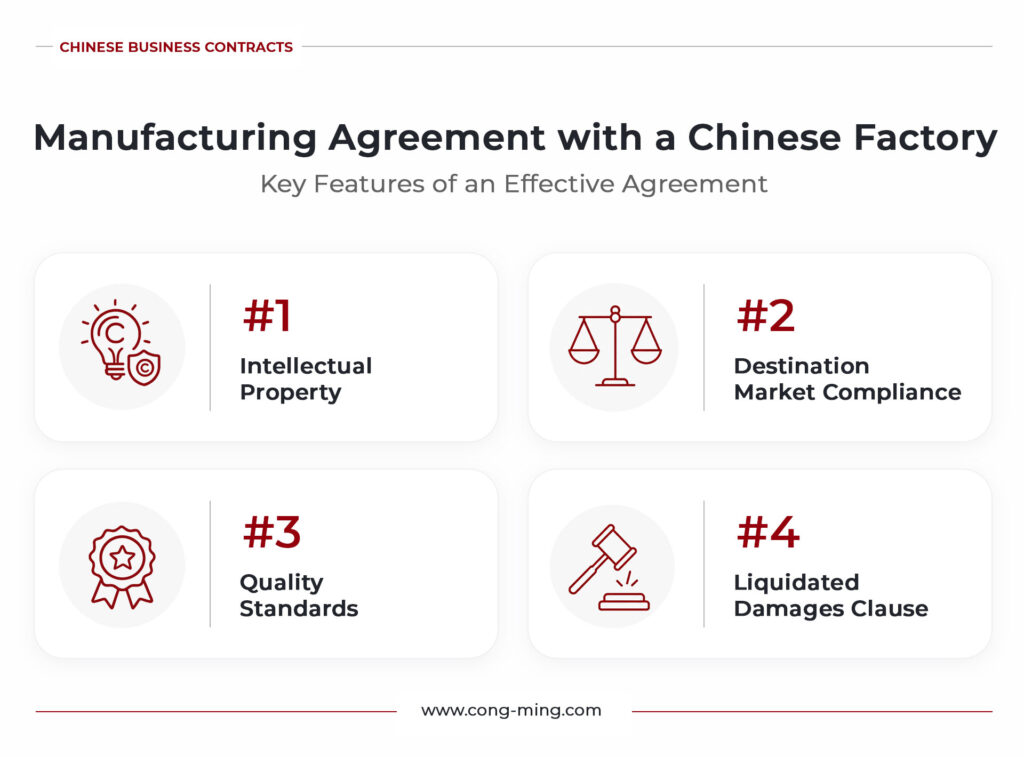
Before drafting a Manufacturing Agreement with a Chinese Factory, it is important to carefully consider all aspects of the project. Doing so helps protect the buyer’s interests and reduce the risk of potential problems. The agreement should be drafted with precision and include detailed provisions relating to product specifications, delivery schedules, payment terms, quality standards, intellectual property protection and dispute resolution procedures. Manufacturing products overseas presents a number of challenges, including cultural differences, language barriers and differing legal systems. For this reason, a Manufacturing Agreement with a Chinese Factory should address all foreseeable scenarios and circumstances that may affect the successful completion of the order.
#1
There a Risk of Intellectual Property Infringement?
Trademarks
When outsourcing manufacturing to China, it is essential to properly identify and protect intellectual property rights. As a first step, businesses should secure Trademark Registration in China. Failure to do so can have serious consequences. Without timely trademark registration, there is a real risk that the brand may be registered by an unscrupulous Chinese company or a competing third party. As a result, the legitimate owner may lose the ability to legally manufacture or sell products bearing its own trademark within China.
n such situations, businesses may consider taking steps to recover trademark rights in China. However, this is often a lengthy, costly and uncertain process. For this reason, when drafting a Manufacturing Agreement with a Chinese Factory, it is important to clearly define the rules governing the use of the brand by the manufacturer from the outset. Doing so helps reduce the risk of potential infringements. For example, will the manufacturer be authorised to use the trademark solely for the purpose of fulfilling orders placed by the foreign business? Will it be permitted to manufacture or sell products bearing the trademark on its own behalf or for the benefit of third parties? These issues should be expressly addressed in the section of the agreement dealing with the Trademark Licence Agreement granted to the Chinese factory.
Copyrights
Another important consideration is the protection of graphic materials and other works protected by copyright. These may include packaging designs, product manuals and marketing materials provided to the factory in order to adapt the final product to EU regulatory requirements and the brand’s visual identity. The Manufacturing Agreement should therefore contain provisions prohibiting the factory from sharing such materials with other customers.
Based on our experience working with China, situations of this kind are unfortunately not uncommon. Manuals and packaging designs prepared by Chinese factories are often of poor quality, difficult to understand and may fail to meet applicable EU requirements. As a result, businesses frequently invest time and resources into creating their own compliant versions and then provide them to the manufacturer. Once the factory has access to editable electronic files, it may be tempted to modify those materials and reuse them for the benefit of other customers.
Patents, Designs, and Utility Models
The essence of ODM manufacturing is the ability to create products under a private label at a relatively low cost. In this model, the factory has already developed the manufacturing process, technical specifications and overall product design. At the customer’s request, manufacturers will often introduce minor modifications, such as changes to dimensions, colours, materials or packaging.
In such cases, the factory should hold the necessary patent, design or utility model rights relating to the product. The Manufacturing Agreement should therefore include provisions granting the buyer the right to use those intellectual property rights to the extent necessary for the fulfilment of the order. Equally important is ensuring that the factory has the legal right to manufacture and sell the product in the first place. Businesses should consider how to protect themselves against situations where a factory has copied a product developed by a third party and is manufacturing it without authorisation.
A good example is the “hanging egg chair”, which was highly popular a few years ago. Many Chinese factories offered this product at very competitive prices. However, within Poland the design was protected as a registered industrial design. As a result, online marketplaces and other sales channels restricted the sale of the product by businesses that did not hold the necessary rights. This demonstrates the importance of verifying the intellectual property status of a product before placing an order with a Chinese manufacturer.
#2
Placing Products on the EU Market and Regulatory Compliance
A manufacturer is a person or entity that produces a product, or has a product designed or manufactured on its behalf, and then places that product on the market under its own name or trademark. Before products can be placed on the European Union market, manufacturers are required to carry out a comprehensive risk assessment to ensure compliance with applicable EU legislation. This process, commonly referred to as a conformity assessment, covers both the design and manufacturing stages of the product.
Regardless of whether the design and manufacturing activities are outsourced to subcontractors in China, responsibility for the conformity assessment remains with the manufacturer. The results of this assessment must be included in the product’s technical documentation. Manufacturers are also required to identify which EU regulations and standards apply to their products. Determining whether harmonised standards exist can significantly assist in demonstrating compliance with EU requirements. In addition, importers placing products originating outside the EU on the European market must ensure that all applicable conformity assessment obligations have been properly fulfilled.
For this reason, when outsourcing manufacturing to China, it is particularly important to sign a comprehensive manufacturing agreement with the Chinese factory. The contract should clearly define all requirements applicable to the product being ordered. It is important to understand that many Chinese factories have only limited knowledge of European regulations and compliance requirements. Technical documentation, conformity assessment records, and test reports provided by manufacturers are often incomplete and, in some cases, unreliable. It is not uncommon for an initial review of factory documentation to reveal that the documents available are insufficient to legally and safely place the product on the European market.
Why Does a Manufacturing Agreement with a Chinese Factory Improve Product Safety?
A manufacturing agreement with a Chinese factory should clearly specify all regulatory and technical requirements applicable to the product. The company placing the product on the European market is responsible for ensuring compliance with EU legislation. Products that fail to meet these requirements cannot legally be sold within the European Union. For this reason, clearly defining and enforcing compliance requirements within the manufacturing agreement is essential.
- The Agreement Should Clearly Define Product Requirements
In many cases, simply listing the numbers of applicable European standards is not sufficient. Chinese factories may not fully understand the practical implications of specific EU regulations or harmonized standards. Therefore, the contract should describe the actual requirements the product must satisfy rather than relying solely on references to legal provisions or technical standards. - It Is Important to Determine Whether CE Marking Is Required and to Allocate Responsibility for the Conformity Assessment
Before production begins, it should be determined whether the product is subject to CE marking requirements and whether a conformity assessment must be carried out. For certain categories of products, the manufacturer may perform the conformity assessment independently. However, EU legislation also specifies situations in which the assessment must be conducted by a notified body. Such bodies are established within the European Union and are authorised to issue certificates only within their designated areas of competence.
When negotiating the Manufacturing Agreement, the parties should clearly define who will be responsible for completing the conformity assessment process. This is an important issue, as compliance activities often involve additional procedures, testing and certification costs that may significantly affect the final cost of the product.
- Attach Technical Documentation to the Agreement
Where possible, the manufacturing agreement should include or reference the product’s technical documentation. Technical documentation contains information relating to the design, manufacture, operation, and safety characteristics of the product. It should also include all information necessary to demonstrate compliance with applicable legal requirements and support the EU Declaration of Conformity.
- Include an EU Declaration of Conformity Template
The EU Declaration of Conformity is a mandatory document for many products. By signing this declaration, the manufacturer confirms that the product complies with all relevant EU requirements and accepts full responsibility for its conformity with applicable legislation. Including a template or agreed format within the contractual documentation can help avoid misunderstandings and ensure consistency throughout the compliance process.
- Include Approved Labels and Markings
Many products require specific labels or markings before they can be sold in the European Union. Examples include CE markings, energy labels, safety warnings, and other mandatory product information. The manufacturing agreement should specify which labels are required and include approved artwork or templates where appropriate.
- Include Product Manuals and Safety Instructions
Products placed on the European market often require user manuals and safety information. Such documentation should be prepared in a language that can be easily understood by consumers and end users in the target market. The agreement should clearly specify who is responsible for preparing, reviewing, translating, and approving these materials before production begins.
Contractual Penalties in a Manufacturing Agreement with a Chinese Factory
In OEM manufacturing agreements with Chinese suppliers, contractual penalties play a critical role in protecting the buyer’s interests. Such provisions help ensure that the factory complies with agreed delivery schedules, quality requirements, confidentiality obligations, and intellectual property protections. To be effective, contractual penalties must be clearly defined and drafted in accordance with Chinese law.
Financial Penalties for Delivery Delays: The agreement should include provisions establishing penalties for late deliveries. A common approach is to impose a penalty calculated as a percentage of the order value for each day of delay. Such provisions create a strong incentive for the supplier to adhere to agreed production and delivery schedules. This is particularly important when delayed deliveries could result in financial losses, missed sales opportunities, contractual penalties imposed by customers, or disruptions to supply chains.
Penalties for Quality Defects: The manufacturing agreement should clearly define the quality standards that the products must meet. Where products fail to satisfy the agreed specifications, the contract may require the supplier to replace the goods at its own expense, reimburse inspection costs, compensate the buyer for losses, or provide discounts on future orders. Clearly defined quality requirements and corresponding penalties encourage the factory to maintain consistent production standards and reduce the likelihood of disputes.
Protection of Intellectual Property Rights: The agreement should include contractual penalties for violations of intellectual property rights. These may apply, for example, where the manufacturer produces quantities exceeding those authorised under the agreement or sells products to third parties without the buyer’s consent. Such provisions help deter unauthorised production and distribution, while providing the buyer with additional legal remedies in the event of a breach.
Quality Control and Enforcement Mechanisms: A manufacturing agreement should clearly define quality control procedures and product acceptance criteria. This may include pre-production inspections, in-process inspections, laboratory testing, and pre-shipment inspections.The agreement should also specify when ownership and acceptance of the goods occur and establish procedures for handling defective products. Well-defined inspection procedures help minimize disputes and make it easier to enforce contractual penalties if problems arise.
From a legal perspective, contractual penalties should be realistic and proportionate to the potential damage suffered by the buyer. Chinese courts and arbitration tribunals may reduce penalties that are considered excessive or disproportionate to the actual loss incurred.
It is often advisable to introduce escalating penalties for repeated breaches of contract. Such provisions can encourage better compliance and provide additional leverage when dealing with recurring issues. To maximize enforceability, the agreement should clearly define quality standards, acceptance criteria, inspection procedures, deadlines, and dispute resolution mechanisms.
An effective Manufacturing Agreement should be preceded by Chinese Supplier Verification and a thorough assessment of the risks associated with the proposed cooperation. Depending on the value and complexity of the project, businesses may choose to conduct a BASIC Verification Report, a PRO Verification Report or a Factory Audit in China. Such an assessment not only helps evaluate the reliability of the manufacturer, but also enables the verification of its official registration details, which should be accurately reflected in the agreement. Relying on incomplete, inaccurate or outdated company information may significantly complicate the enforcement of contractual rights and the recovery of claims in the event of a dispute.
Summary
Working with Chinese factories can create significant business opportunities, but it also involves substantial risks when proper contractual safeguards are not in place. Importers frequently make costly mistakes by placing excessive trust in suppliers, underestimating the importance of a manufacturing agreement, or attempting to avoid the costs associated with professional legal support. Without a properly drafted contract, businesses may encounter product quality issues, delivery delays, intellectual property violations, and difficulties enforcing agreed terms.
A manufacturing agreement prepared in accordance with Chinese law provides an effective framework for protecting the buyer’s interests. It clearly defines the rights and obligations of both parties, establishes mechanisms for resolving disputes, and creates a solid foundation for enforcing contractual commitments. Ultimately, a professionally drafted manufacturing agreement is one of the most important tools for reducing risk and ensuring the successful completion of manufacturing projects in China.

Manufacturing Agreement with a Chinese Factory
Do not wait until product quality issues or delivery delays disrupt your business. Invest in a professionally drafted OEM manufacturing agreement prepared by legal professionals familiar with Chinese law and business practices. Ensure that your orders are properly protected and that the agreed terms can be effectively enforced.
Contact us today to develop a manufacturing agreement that provides full protection and greater control over your production process in China.

