A trademark registrability search in China involves examining two critical aspects of a brand. First, it determines whether a company name, logo, or other sign is capable of obtaining trademark protection before the Chinese trademark authority. Second, it assesses whether the use of the proposed mark may infringe the rights of third parties or otherwise violate applicable laws. Ideally, this type of analysis should be carried out at the earliest stage of brand development, when choosing a company name, logo, domain name, or other brand identifiers.
If it turns out that the proposed name or logo is not registrable, or worse, that its use infringes the rights of others, it is far better to discover this before entering the market.
In practice, many brands are first developed in their domestic market and only later expand internationally. From this perspective, conducting a trademark registrability search in China is an essential step before entering the Chinese market. A professional trademark search can significantly improve the chances of successful registration before the Chinese trademark authority. It helps determine whether the trademark is eligible for protection and whether its use may violate the rights of third parties.
If the search identifies potential obstacles to registration, a trademark attorney can recommend modifications that may increase the likelihood of obtaining protection. Conducting a trademark search before filing an application can save considerable time and expense that would otherwise be spent pursuing registration of a mark that ultimately cannot be protected. More importantly, the search also evaluates whether the proposed mark may infringe existing rights or violate legal requirements. This is particularly valuable because it helps businesses avoid unlawful conduct, costly disputes, compensation claims, and litigation.
What Does a Trademark Registrability Search Involve?
A trademark registrability search in China consists of analysing a specific trademark, logo, or brand name to determine whether it can be successfully registered before the Chinese trademark authority.
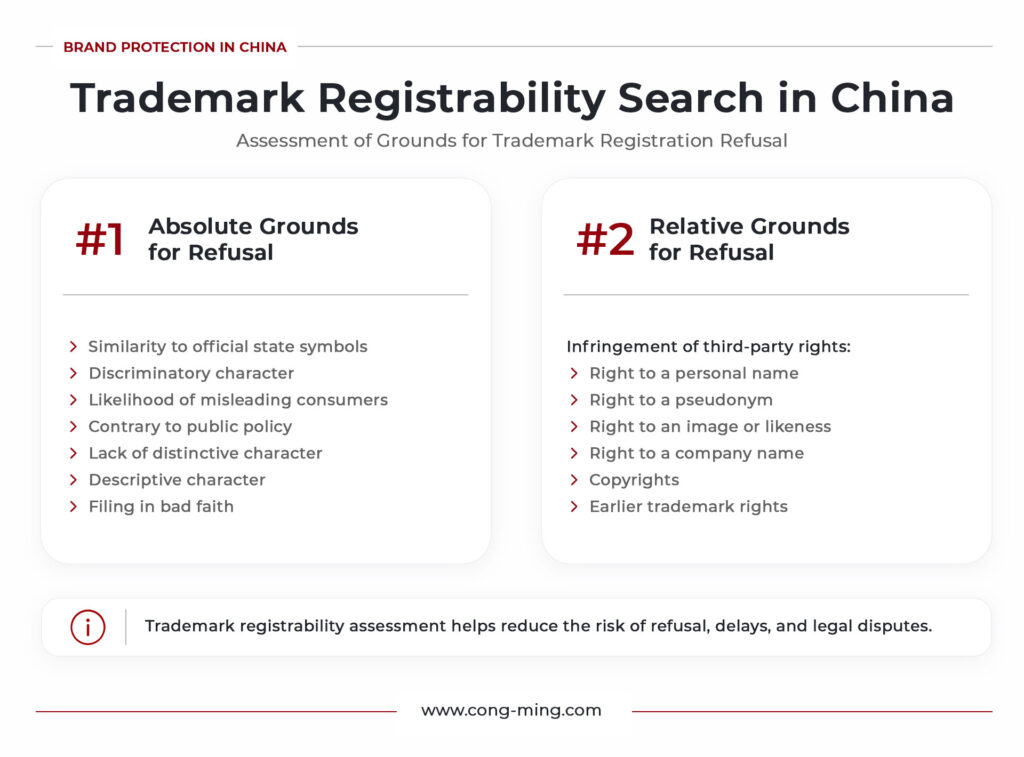
- Absolute grounds for refusal
- Relative grounds for refusal
Absolute Grounds for Refusal
The first step in a trademark registrability search is assessing whether any absolute grounds for refusal apply. These are circumstances under which the Chinese trademark authority may reject an application regardless of whether third-party rights are involved. Under the Trademark Law of the People’s Republic of China, the list of absolute grounds for refusal is relatively broad. It includes, among other things, signs that are similar to state symbols, discriminatory, deceptive, contrary to public policy or accepted principles of morality, devoid of distinctive character, descriptive in nature, or filed in bad faith. In practice, the most common absolute grounds for refusal of trademark registration in China are lack of distinctiveness and bad-faith trademark applications.
To function as a trademark, a sign must be capable of distinguishing the goods or services of one business from those of others. It must therefore possess distinctive character and not merely describe the products or services offered. A sign is considered descriptive if it consists exclusively of elements that indicate the type, origin, quality, quantity, purpose, or characteristics of the goods or services. A sign is considered descriptive if it consists exclusively of elements that indicate the type, origin, quality, quantity or other characteristics of the relevant goods or services. Descriptive trademarks are a common issue in practice. This is largely because, from a marketing perspective, businesses often want their brand name to be closely associated with the products or services they offer. However, the line between a suggestive trademark and a descriptive one is often very thin. For example, the name “Fresh Bread” for a bakery business would generally be regarded as descriptive, as it directly refers to both the quality of the products (“fresh”) and the type of goods being offered (“bakery products”).
Relative Grounds for Refusal
If the proposed trademark successfully passes the assessment of the absolute grounds for refusal, the next step is to determine whether it conflicts with any relative grounds for refusal. Relative grounds for refusal are those that arise from the prior rights of third parties. Particular attention should be paid to: personal names, surnames, pseudonyms, image rights, company names, copyrights, earlier trademark registrations. This stage is typically the most complex part of the trademark search because it requires detailed analysis of a broad range of existing rights.
Copyright issues most frequently arise in relation to logos. Businesses should ensure that appropriate agreements have been signed with the designers who created the logo.
Such agreements should confirm that the work does not infringe third-party rights and should include a transfer of economic copyrights together with permission to register the logo as a trademark. It is equally important to verify that the proposed trademark does not conflict with earlier trademark registrations.
The search should cover not only identical marks but also marks that may be considered confusingly similar. While identifying identical trademarks is relatively straightforward, assessing similarity requires a detailed legal analysis of visual, phonetic, and conceptual similarities, as well as the likelihood of consumer confusion. For this reason, it is highly advisable to entrust trademark clearance searches to experienced professionals.
Examination by the Chinese Trademark Authority
Once a trademark application has been filed, the Chinese trademark authority generally takes approximately four months to issue its initial decision regarding registration.
As part of this process, trademark examiners conduct an official examination of the mark’s registrability. China operates under an examination system. This means that the trademark authority reviews not only absolute grounds for refusal but also conducts a preliminary assessment of potential conflicts with earlier rights held by third parties. This provides an additional layer of protection for applicants by reducing the risk of obvious infringements and registration conflicts.
However, it is important to understand that the examination conducted by the Chinese trademark authority is not as comprehensive as a professional trademark clearance search performed by an experienced trademark attorney. Furthermore, once the trademark application has been published, third parties have three months to file an opposition if they believe the proposed trademark infringes their rights.
What happens if a trademark infringes the rights of another party, but this is not identified during the preliminary examination conducted by the China National Intellectual Property Administration (CNIPA), and the owners of the earlier rights fail to take action before the trademark is registered? In such circumstances, the owners of the prior rights may still apply for the invalidation of the trademark, in some cases for up to five years following its registration. Alternatively, they may choose to initiate court proceedings directly in order to enforce their rights and seek appropriate remedies. For this reason, trademark registration alone does not guarantee that the use of a brand is lawful. This can create serious difficulties for the owner of a later-registered trademark. If significant investments have already been made in marketing, branding, distribution, or market entry activities, those activities may need to be discontinued immediately. In many cases, the trademark owner may also face substantial damages claims brought by the holder of the earlier rights.
Comparison with the European Union and with the United States Trademark System
The European Union Intellectual Property Office (EUIPO) primarily examines trademark applications on the basis of absolute grounds for refusal, such as descriptiveness, lack of distinctiveness, or conflicts with public policy. Unlike the Chinese system, EUIPO generally does not conduct a full examination of earlier trademark rights. Instead, owners of prior trademarks are responsible for monitoring new applications and filing oppositions where necessary. As a result, trademark applicants must take greater responsibility for conducting a comprehensive trademark registrability assessment before filing their application. Takie rozwiązanie nakłada na zgłaszającego znak towarowy jeszcze większą odpowiedzialność za przeprowadzenie szczegółowego badania zdolności rejestrowej.
For this reason, conducting a trademark clearance search before filing remains essential, as registration does not guarantee that a trademark does not infringe the rights of third parties.
The United States Patent and Trademark Office (USPTO) conducts a more comprehensive examination than EUIPO and reviews both absolute grounds for refusal and potential conflicts with earlier trademark registrations. In this respect, the US system is more similar to the Chinese examination system.
However, an important difference is that trademark rights in the United States may arise through actual use of a mark in commerce, whereas China largely follows a first-to-file system. As a result, businesses entering the Chinese market should conduct a thorough trademark clearance search and secure trademark registration as early as possible.
Although the trademark systems in China, the European Union, and the United States differ in important respects, they share one common feature: trademark registration alone does not guarantee that a brand can be used without legal risk. Whether a trademark application is examined only on absolute grounds, as in the European Union, or undergoes a broader review of prior rights, as in China and the United States, the ultimate responsibility for ensuring that a trademark does not infringe third-party rights remains with the applicant.
Summary
Conducting a professional trademark registrability search before filing a trademark application is strongly recommended for any business seeking protection in China. A comprehensive trademark search helps determine whether a trademark is likely to qualify for registration and identifies potential obstacles before the application is filed. This can save significant time and expense that might otherwise be wasted pursuing registration of a trademark that cannot ultimately be protected.
More importantly, a trademark registrability search serves an even more critical purpose. It provides a detailed assessment of whether the proposed trademark can be legally used in China without infringing the rights of third parties. Trademark rights are territorial in nature. The fact that a brand may be lawfully used in one country does not mean that it can be used legally in another.
As explained above, it is entirely possible for a trademark to obtain registration while still infringing earlier rights. For this reason, businesses entering the Chinese market should ensure that the legality of their trademark is thoroughly assessed before launching products, investing in marketing, or building brand recognition. A professional trademark search helps prevent costly disputes, invalidation proceedings, litigation, and compensation claims, while providing greater confidence when expanding into China.


Trademark Registrability Search in China
Do not expose your brand to unnecessary legal risks or avoidable costs. Invest in a professional trademark registrability search in China and ensure that your company name, logo, and other brand identifiers can be legally registered and used in the Chinese market.
Contact us today to have your brand professionally assessed and enter the Chinese market with confidence.

