Conducting business internationally presents significant challenges for many companies. Before entering the Chinese market, businesses should ensure that their trademarks are properly protected. Delaying the registration of a company name, brand, or logo may result in the trademark being registered by another party. This can lead to the loss of the right to use and control the brand throughout China. More information about trademark registration in China and recovering misappropriated trademark rights can be found in our dedicated articles.
It is important to remember that trademark rights in China are granted for a fixed period of time. Once the protection period expires, the trademark rights lapse. For this reason, trademark renewal in China is essential. To maintain trademark protection and prevent the loss of rights, trademark owners must file a renewal application with the China National Intellectual Property Administration (CNIPA) before the protection period expires.
How to Renew a Trademark in China
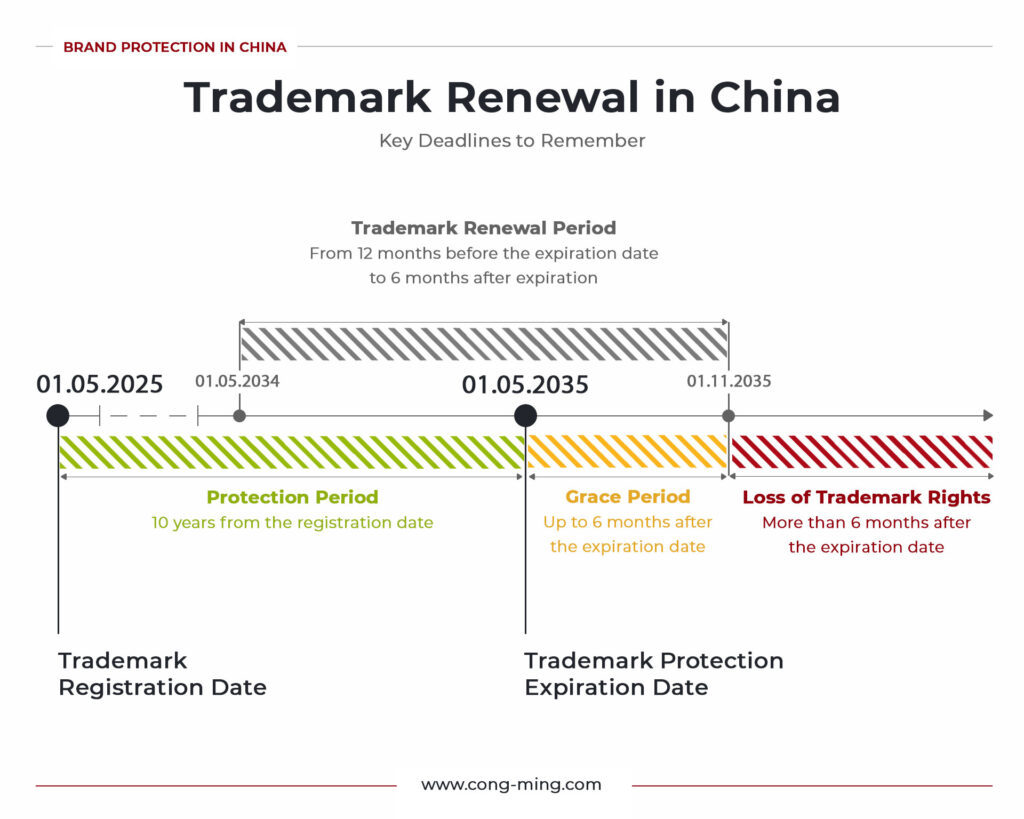
Once a trademark has been successfully registered, the owner is granted exclusive trademark rights. Under Chinese law, trademark protection is granted for a period of ten years from the registration date. If the trademark is not renewed, the registration will expire upon completion of the protection period. However, trademark protection may be renewed indefinitely for successive ten-year periods.
In China, trademark renewal applications may only be filed by Chinese entities or through authorized Chinese trademark agents. The renewal process involves strict administrative requirements and mandatory deadlines. In addition, all proceedings before CNIPA are conducted in Chinese. As a result, all formal applications and supporting documentation must be submitted in Chinese in order to be accepted.
To renew a trademark registration in China, the trademark owner must provide copies and Chinese translations of documents confirming the owner’s identity. For individual trademark owners, this may include a copy of a passport. For companies, documents confirming the legal existence of the business will generally be required, such as a company registration certificate or equivalent corporate records. The renewal application must also include a copy of the Chinese trademark registration certificate, a power of attorney in Chinese and supporting identification documents for the trademark owner.
When Should a Trademark Renewal Application Be Filed?
Trademark renewal proceedings should be initiated before the trademark registration expires. The exact expiration date can be verified through the official trademark records maintained by CNIPA. The date is also indicated on the trademark registration certificate. Trademark owners should keep careful track of this deadline.
In China, a trademark renewal application may be filed up to twelve months before the expiration date of the registration. However, businesses should not wait until the last moment. CNIPA may require several months to process the renewal application. As a result, it is generally advisable to submit the application no later than three to four months before the expiration of the current protection period.
Grace Period
What happens if the trademark owner realizes that the registration has expired? Chinese trademark law provides a six-month grace period following the expiration of the trademark registration. During this period, the trademark owner may still file a renewal application and maintain protection for the trademark. In practice, this means that CNIPA will not register identical or confusingly similar trademarks during the grace period. It should be noted, however, that renewing a trademark during the grace period is significantly more expensive than filing a renewal application before the expiration date.
Permanent Loss of Trademark Rights
When Is Trademark Renewal No Longer Possible?
If more than six months have passed since the expiration of the trademark registration and no renewal application has been filed, the trademark rights are permanently lost. This can create a highly risky situation, particularly for businesses that continue to operate in China or maintain relationships with Chinese business partners.
Once trademark protection has permanently expired, any third party may appropriate the trademark. At that point, anyone may freely use the brand for commercial or marketing purposes. However, this is not the most serious consequence.
The greatest risk is that another party may apply to register the trademark in its own name with CNIPA. If this occurs, the legitimate trademark owner may not only lose control of the brand but may also lose the legal right to use it in China altogether. In such circumstances, the former trademark owner should immediately consult a Chinese trademark attorney to assess the current legal status of the trademark and determine what remedies, if any, remain available.
Summary
Renewing a trademark registration in China is just as important as obtaining the registration in the first place. Both procedures serve the same purpose: ensuring that the legitimate trademark owner retains exclusive rights to the brand. Although the renewal process requires careful attention and strict compliance with deadlines, it is essential for maintaining full control over a trademark in China.
If the trademark owner fails to renew the registration in a timely manner, the trademark rights will expire. Permanent loss of trademark protection can lead to serious business consequences and expose the brand to appropriation by third parties. Once trademark rights have lapsed, the trademark becomes vulnerable to registration by competitors, business partners, or unrelated third parties seeking to exploit the brand’s reputation and commercial value.

Trademark Renewal in China
Do not risk permanently losing your trademark rights in China. Filing a renewal application too late may result in the expiration of your trademark registration and the loss of valuable legal protection. Let us handle your trademark renewal and ensure that your brand remains protected for years to come.
Contact us today to maintain your trademark rights in China and safeguard your brand for the future.

