Under certain circumstances, businesses that have lost the right to use their own trademark in China may be able to recover their trademark rights. Such situations typically arise when an identical or similar trademark has already been registered in China by another party. Although recovering trademark rights in China is possible, the process is rarely straightforward.
China operates a first-to-file trademark registration system. This means that trademark rights are generally granted to the party that files the application first. As a result, any subsequent applications for identical or similar trademarks filed by other parties, including the legitimate owner of the brand, will usually be refused.
If a trademark has been registered by someone else, the registrant may rely on administrative, civil, and even criminal proceedings. These measures may be used to prevent the legitimate trademark owner from manufacturing, selling, importing, or exporting goods anywhere in China.
More information about trademark registration in China can be found in a separate article. That article also explains which businesses are most vulnerable to losing trademark rights in China and outlines the legal remedies available for enforcing trademark rights in the Chinese market. We also encourage you to familiarize yourself with the legal mechanisms available for enforcing trademark rights in China.
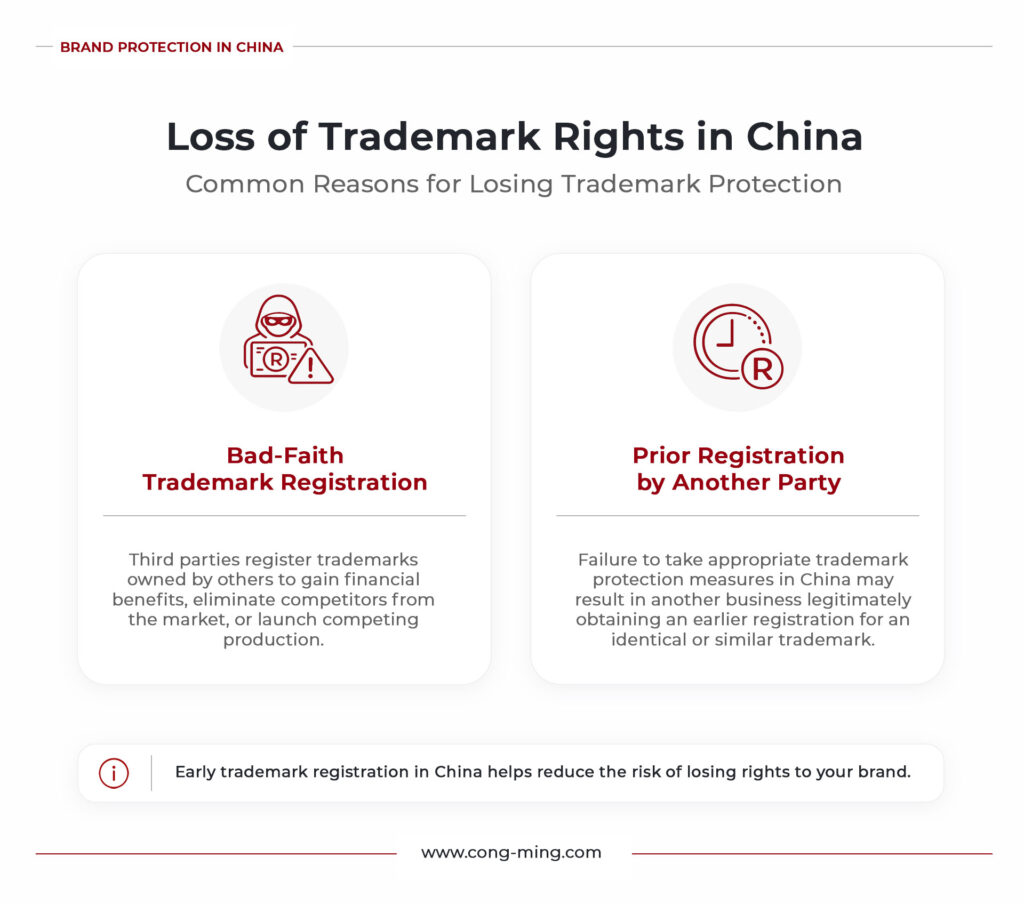
The legal tools available for recovering trademark rights in China depend largely on the circumstances surrounding the earlier registration. As a general rule, it is necessary to determine whether the prior registration was made honestly and with a genuine intention to use the trademark, or whether it was filed in bad faith.
One of the most common forms of bad faith in China involves trademark squatting, which remains a widespread problem. If a trademark was registered in bad faith and the legitimate brand owner is able to provide convincing evidence of that fact, the chances of recovering the trademark are significantly higher than in situations where a third party registered the trademark legitimately and actively uses it in commerce.
Loss of Trademark Rights as a Result of Bad-Faith Registration
Many foreign businesses attempting to enter the Chinese market face the problem of their trademarks being registered in bad faith. In China, bad-faith registration generally refers to a situation in which a party deliberately registers a trademark that belongs to someone else. It is important to note that entities engaging in trademark squatting no longer target only large corporations. Small and medium-sized enterprises are increasingly affected by this practice.
What happens if the legitimate owner of a brand discovers that another party has registered its trademark in China in bad faith? Under certain circumstances, it may be possible to invalidate such a registration. However, invalidating a bad-faith trademark registration and recovering trademark rights in China is far from straightforward. Chinese case law provides numerous examples of circumstances that may constitute bad faith.
The most common examples of bad-faith trademark registrations include:
- Use of Dishonest or Unlawful Methods
Such methods may involve the falsification of signatures, company seals, or documents, including identity documents or company registration certificates, for the purpose of obtaining trademark registration. This category also includes entities that systematically register and sell trademarks on a large scale.
- Lack of Genuine Intent to Use the Trademark
Registering a trademark without any genuine intention of using it may constitute bad faith. This may occur where the applicant’s sole objective is to obtain financial compensation through the sale of the trademark rights. Another indication of bad faith may be the mass registration of numerous trademarks without any logical business justification.
- Infringement of Well-Known Trademarks
Well-known trademarks enjoy protection in China against copying, transliteration, and translation. Accordingly, the registration of a trademark identical or similar to a well-known trademark may be regarded as a bad-faith filing. It should be noted, however, that obtaining well-known trademark status in China is extremely difficult for foreign brands.
- Registration by Related Parties
Chinese law also imposes restrictions on parties that have had prior business or other relationships with the trademark owner. Where a party becomes aware of a trademark through such a relationship, it may be prohibited from registering that trademark. In order for this provision to apply, the trademark must generally have been used in China before the disputed registration.
- Identity or Similarity of Signs
This ground is often relied upon as an additional argument supporting a claim of bad faith. Where a trademark is identical or highly similar to an earlier work protected by copyright, its registration may be regarded as evidence of bad faith.
Trademark Squatting in China and Recovering Trademark Rights
As mentioned above, trademark squatting remains one of the most common forms of bad-faith trademark registration in China. It is a widespread practice whereby a party registers someone else’s trademark in order to demand compensation at a later stage or offer to sell the trademark rights back to the legitimate owner at an inflated price. Businesses planning any form of presence in the Chinese market should therefore ensure that their trademarks are registered in China. It is important to obtain trademark registration well in advance of entering the Chinese market.
It should also be remembered that bad faith is assessed on a case-by-case basis. One of the greatest challenges is building a persuasive legal case and gathering properly documented evidence demonstrating the applicant’s bad faith.
Proceedings aimed at invalidating a bad-faith trademark registration and recovering trademark rights in China are therefore often complex and time-consuming. Nevertheless, where the legal requirements established under Chinese law are satisfied and the legitimate trademark owner possesses sufficient evidence, there may be a realistic opportunity to recover the trademark rights.
Loss of Trademark Rights as a Result of a Legitimate Prior Registration
A more difficult situation arises where a trademark owner simply failed to take timely steps to protect its intellectual property rights. This concerns businesses that did not register their trademarks early enough. If another party has already registered an identical or similar trademark in compliance with Chinese law, recovering the trademark rights may be extremely difficult. In addition, the process may involve costly, burdensome, and lengthy proceedings, particularly where the registrant actively uses the trademark in commerce.
Several options may be available in such circumstances. The most favourable solution is the cancellation of the earlier trademark registration. However, a non-use cancellation action may generally be initiated only after three years have passed from the registration date. If the trademark has not been genuinely used during that period, CNIPA may revoke the registration. Once the earlier registration has been cancelled, trademark protection may become available for the legitimate brand owner.
If, however, the earlier registrant actively uses the trademark, CNIPA will not revoke the registration on the grounds of non-use. In such cases, negotiations with the trademark owner may be considered. The owner may be willing to grant a licence or sell the trademark rights, usually in exchange for financial compensation. Such negotiations may also provide an opportunity to gather additional evidence, particularly where there is reason to suspect that the trademark was originally registered in bad faith. For this reason, negotiations are generally best conducted through a local Chinese lawyer.
Is It Worth Trying to Recover Trademark Rights in China?
For many years, the widespread problem of bad-faith trademark registrations remained largely unresolved in China. However, amendments to the Trademark Law of the People’s Republic of China introduced in 2019 and 2023 were specifically designed to combat such practices and gradually improve the trademark system.
These reforms have made actions against trademark squatters and efforts to recover trademark rights in China significantly more effective. Chinese case law now provides numerous examples demonstrating the application of this policy in order to protect legitimate trademark owners.
Given the importance of trademarks as valuable business assets, taking all reasonable steps to protect them is essential. A strong and recognizable brand plays a crucial role in attracting new customers and retaining existing ones. By contrast, the use of a trademark by unauthorized parties in a manner inconsistent with the brand’s values may cause serious reputational and financial harm. In these circumstances, successfully recovering trademark rights becomes particularly valuable. Building a brand’s reputation requires substantial time, effort, and investment. For that reason, it is always worth protecting what has already been achieved.
Summary
Many businesses have encountered situations where their trademarks were registered in China by someone else. Trademark squatting remains a relatively common problem in a first-to-file system such as China’s. However, recent amendments to Chinese trademark law have significantly strengthened the fight against bad-faith trademark filings. This policy is increasingly reflected in Chinese case law and is proving more effective in practice.
Recovering trademark rights in China involves several stages, and the appropriate legal strategy depends on the specific circumstances of each case. The first step is therefore a careful assessment of the situation. Such matters generally require the involvement of a local Chinese lawyer. Foreign companies cannot represent themselves before CNIPA and must act through an authorized Chinese representative. Moreover, only a lawyer with extensive experience in Chinese trademark law will be able to recommend the most effective recovery strategy. All documentation must also be prepared in Chinese. Recovering trademark rights in China may require multiple legal procedures, including invalidation of a bad-faith registration, cancellation of trademark rights, or negotiations with the party that registered the trademark.
It is important to remember that recovering trademark rights is almost always more complicated, expensive, and time-consuming than registering the trademark at an early stage. As in many areas of business, prevention is far better than cure. For this reason, companies planning any form of activity in China should make trademark registration one of their first priorities.

Recovering Trademark Rights in China
Have you lost the ability to use your own brand in China? You may still have an opportunity to recover your trademark rights. Although recovering trademark rights in China can be complex, it is often possible, particularly where the trademark was registered in bad faith. The Chinese legal system may work in your favour if you act quickly and pursue the right legal strategy.
Contact us today to learn how to recover your trademark rights in China and protect your brand for the future.

