Trademark registration in China is one of the most important steps for businesses planning to expand into the Chinese market. China grants trademark rights for a period of ten years under a first-to-file system. This means that the party who first files a trademark application with the Chinese trademark authority obtains the exclusive right to use the mark. Any later applications for identical or similar trademarks filed by other parties will generally be refused.
To avoid a situation where someone else registers your brand first, trademark protection should be secured as early as possible. Ideally, an application should be filed at least one year before commencing any commercial activities related to China.
Many businesses mistakenly believe that trademark protection in China is only relevant for companies intending to sell products or services in the Chinese market. This assumption is incorrect. An increasing number of companies that have no intention of selling in China, but manufacture products there for export to Europe, USA or other markets, face serious and costly consequences because they failed to register their trademarks in China at an early stage.
What Is a Trademark?
A trademark is a sign used in commerce to distinguish the goods or services of one business from those of its competitors. Trademarks play a vital role in building brand recognition, consumer trust, and business value. Under Chinese trademark law, a trademark may consist of words, letters, numbers, acronyms, names, colour combinations, graphical elements, three-dimensional shapes, and other distinctive signs capable of identifying the source of goods or services. Although trademarks may take many different forms, the most common categories are: word trademarks, combined word and device trademarks and device trademarks.
Word Trademarks
A word trademark protects the verbal element of a brand, regardless of the font or graphic presentation used. Businesses intending to market products to Chinese consumers should also consider creating and registering a Chinese-language version of their trademark. This usually involves translating or adapting the brand into Chinese characters. An important distinction should be noted. In many Western jurisdictions, a trademark written exclusively in Chinese characters may be treated as a figurative mark because consumers cannot understand its linguistic meaning. In China, however, trademarks consisting of Chinese characters are generally treated as word trademarks because Chinese consumers read and recognize them as language rather than purely graphical elements. Examples include:
- KFC (CNIPA: 7706968) and its Chinese equivalent 肯德基 (CNIPA: 7706975)
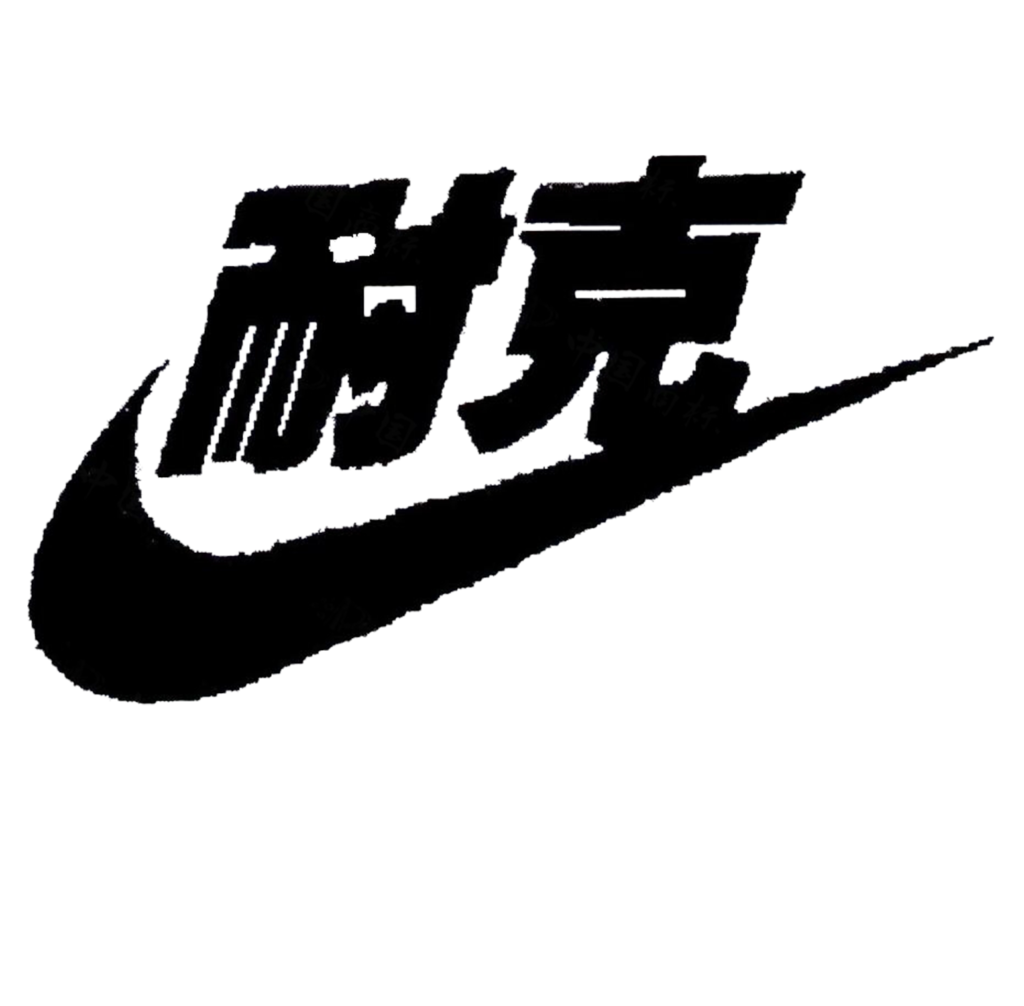
- Nike (CNIPA: 55089853) and its Chinese equivalent 耐克 (CNIPA: 39544863)
- Mercedes-Benz (CNIPA: 526122)
Combined Word and Device Trademarks
A combined word and device trademark contains both textual and graphical elements. In this category, trademark protection applies to the overall appearance of the mark rather than to the individual components separately. Many international brands register combined trademarks to protect their distinctive logos together with the accompanying brand name. For example, the Chinese version of the Nike trademark, 耐克 (Nàikè), would generally be considered a combined word and device trademark in China, whereas in some jurisdictions it may be viewed differently depending on local trademark practice.


Device Trademarks
A device trademark consists solely of graphical elements without any verbal component. Such trademarks are commonly used where a logo itself has acquired strong brand recognition and can identify the source of goods or services without the need for accompanying text. Well-known examples include the graphical logos used by global brands such as KFC, Nike, and Mercedes-Benz.



For a trademark registration in China to succeed, the proposed trademark must possess registrability and comply with the requirements of Chinese trademark law. Before filing an application, it is highly advisable to conduct a professional trademark registrability search. Such an assessment is performed by an experienced trademark attorney and evaluates whether the proposed trademark is likely to be accepted for registration in China. More importantly, the search determines whether the use of the trademark could infringe the rights of third parties. Further information regarding trademark registrability searches in China is available in a separate article.
Who Should Register a Trademark in China and Why?
Growing economic cooperation between China and the European Union has significantly increased the importance of trademark protection in China. The expansion of trade in goods and services, combined with the rapid exchange of information in today’s global economy, creates substantial opportunities for businesses. At the same time, companies engaged in international trade must also be aware of the risks associated with operating on a global scale. An ineffective trademark protection strategy can disrupt business operations and significantly affect long-term growth.
Trademark registration in China is an essential step for companies planning to export products to China. But is it only relevant for businesses entering the Chinese market? Trademark rights are territorial in nature. This means that a trademark is protected only in the countries where it has been legally registered.
If a trademark is protected only in the European Union or another jurisdiction, that protection generally has no legal effect in China. In practice, this means that third parties may legally manufacture goods or offer services under that brand within China. They may also legally advertise and offer such products on widely accessible online marketplaces, including Alibaba and AliExpress.
For this reason, trademark protection in China is important not only for businesses planning to sell products in the Chinese market. China is often referred to as the world’s factory, and for good reason. Even if a company has no current plans to expand into China, few brand owners would want products bearing their trademark to be offered online at a fraction of the price charged by the legitimate business. The rights arising from trademark registration in China and the available enforcement mechanisms are discussed in greater detail in a separate article.
- In particular, trademark registration in China should be a priority for companies manufacturing products in China. Regardless of whether the products are ultimately sold on the Chinese market or exported to Europe immediately after production, it is also advisable to put in place a properly drafted Manufacturing Agreement with a Chinese Factory.
- It is also an important step for international businesses, even if they do not currently operate in the Chinese market.
- Trademark protection in China should also be considered by companies planning to participate in trade fairs, exhibitions, sourcing events, or large-scale marketing activities.
Below are some of the most important reasons why businesses should protect their trademarks in China.
#1
First-to-File Rule and the Lengthy and Costly Process of Recovering Trademark Rights
As mentioned at the beginning of this article, China operates under a first-to-file trademark registration system. This means that exclusive rights to a trademark are generally granted to the party that files the application first with the China National Intellectual Property Administration (CNIPA), regardless of whether that party is the legitimate owner of the brand. As a result, any subsequent applications for identical or similar trademarks filed by other parties, including the rightful brand owner, are likely to be rejected. Wówczas urząd odrzuci wszystkie późniejsze próby rejestracji, identycznych lub podobnych oznaczeń, podjęte przez inne osoby (w tym prawowitego właściciela).
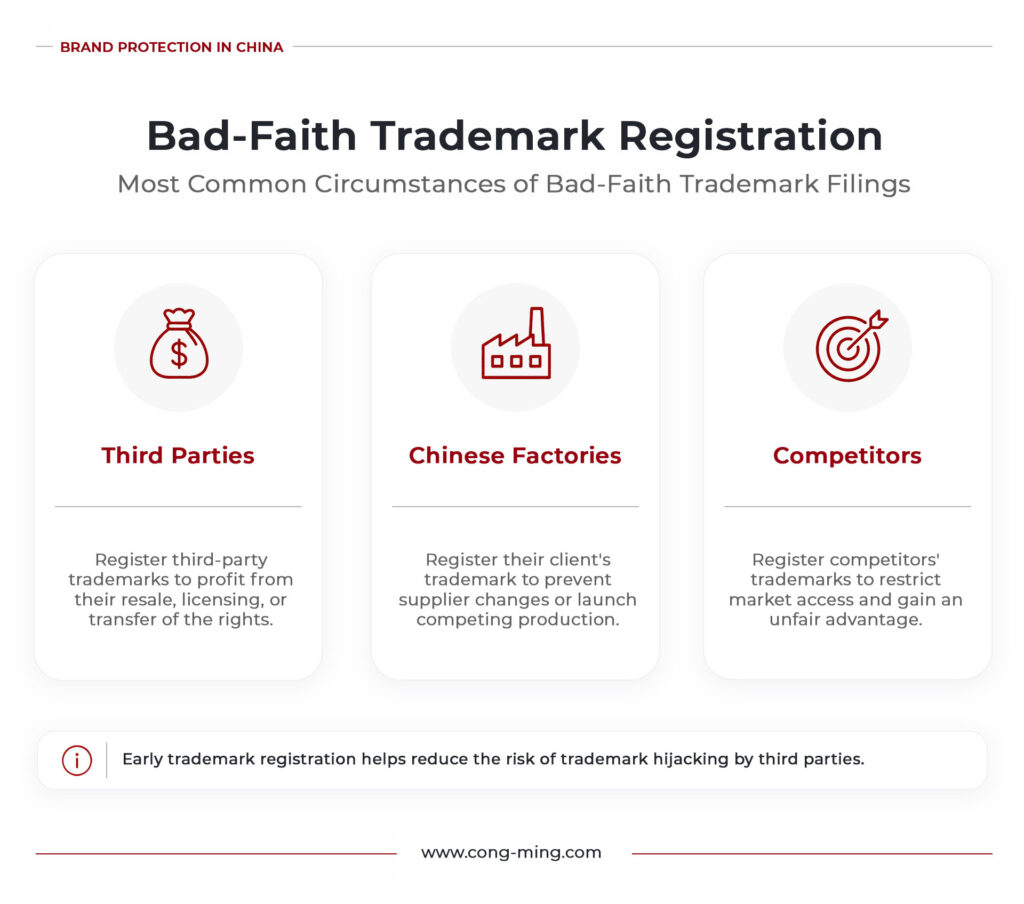
Bad-faith trademark registrations remain a relatively common problem in China. In such cases, an unauthorized party registers a trademark belonging to another business, depriving the legitimate owner of the right to use its own brand. Under certain circumstances, Chinese trademark law provides mechanisms for recovering a trademark that has been wrongfully appropriated.
To challenge a bad-faith registration successfully, it is necessary to provide evidence of the registrant’s bad faith and dishonest intentions. In addition, the trademark owner must demonstrate that other legal requirements set out under Chinese trademark law have been met. Bad-faith trademark filings are one of the most common causes of business disputes in China and affect hundreds of brands every year.
An even more difficult situation arises when a business fails to take the necessary precautions and does not file a trademark application sufficiently early. If another party has already registered an identical or similar mark and is actively using it, the chances of recovering trademark rights may be very low.
In both situations, recovering trademark rights is usually a multi-stage process that depends heavily on the specific circumstances of the case. Trademark recovery proceedings are significantly more expensive than securing trademark protection in advance. They also require considerable time, effort, and involvement from both legal counsel and the trademark owner.
In the most favourable cases, recovering trademark rights may take approximately twenty months. Such outcomes are relatively rare, however. More complex disputes can continue for years before a final resolution is reached. For this reason, registering a trademark before entering the Chinese market or engaging with Chinese business partners is almost always the safest and most cost-effective approach. More information about recovering trademark rights in China can be found in a separate article.
#2
You Do Not Want Products Manufactured in China Under Your Brand to Be Seized for Trademark Infringement
Trademark rights are territorial in nature. Therefore, in order to manufacture products under your own brand in China legally and without disruption, the trademark should be registered with the Chinese trademark authority. If trademark registration is not secured early enough, there is a significant risk that someone else will register it first. Many brand owners manufacturing products in China have discovered that third parties are willing to register their trademarks without hesitation.
This risk may seem obvious when products are manufactured and sold in China. For this reason, most companies operating in the Chinese market register their trademarks at an early stage. However, such situations also occur when products are manufactured in China and immediately exported to Europe or other foreign markets without ever being sold in China. Given China’s role as the world’s manufacturing centre, effective trademark protection in China remains essential even for businesses that do not sell directly to Chinese consumers.
In many cases, a foreign company’s trademark is registered by its Chinese factory or by a competitor. However, unrelated third parties may also engage in this practice. When this happens, the foreign business may lose the ability to continue manufacturing products bearing its own trademark anywhere in China. The party that has registered the trademark obtains the exclusive right to manufacture, store, sell, and advertise products bearing the mark. As a result, that party may obtain an order requiring production of the goods to be stopped immediately. It may even seek the seizure and destruction of products bearing the foreign company’s trademark. Such measures can be taken even when the products are manufactured in China solely for export and are never intended for sale within the Chinese market. The trademark owner may also record its rights with Chinese Customs, enabling customs authorities to monitor and control the import and export of goods bearing the trademark.
Third Parties
Independent third parties typically register foreign trademarks in China for financial gain. They rely on the threat of product seizures and trademark infringement claims to pressure the legitimate brand owner into purchasing a licence or paying to regain control of its own trademark.
Chinese Factories
Chinese factories usually register foreign trademarks for one of two reasons. The first is to launch competing sales of the products. The second is to ensure that the customer remains dependent on the factory indefinitely. Once the factory becomes the registered trademark owner in China, it becomes the only entity legally entitled to use the trademark in the country. As the holder of exclusive rights, it may increase prices without fear of losing the customer. In such circumstances, no other manufacturer in China can legally produce or sell products bearing the same trademark.
Competitors
The worst-case scenario occurs when a competitor registers the trademark first. In most cases, the competitor’s objective is to eliminate the business from the market entirely by blocking the manufacture and export of products bearing the trademark.
#3
You Do Not Want Counterfeit Products Bearing Your Brand to Be Sold Online at a Fraction of the Price
China is often referred to as the world’s factory. According to data published by the United Nations, China is the global leader in manufacturing output. Its share of global industrial production is almost twice that of the United States and more than five times that of Germany. Moreover, virtually anything can be manufactured in China, from simple keychains to highly sophisticated production lines. The scale of China’s manufacturing sector and the ease of global online sales mean that failing to protect a trademark in China can have serious consequences even for companies that have no presence in the Chinese market. This is one of the reasons why most, if not all, global brands have registered their trademarks in China, regardless of whether they manufacture or sell products there.
If a trademark is not registered in China, any third party may apply for exclusive rights to that mark. Once registered, the trademark owner may begin mass production of goods bearing the trademark and sell them at significantly lower prices through local channels or online platforms such as Alibaba, AliExpress, 1688, and Taobao.
The consequences can be devastating, both financially and reputationally. Invalidating a trademark registration, particularly where the registrant actively uses the trademark, may involve lengthy, costly, and burdensome legal proceedings.
#4
You Want Chinese Customs to Seize Goods Bearing Your Trademark Imported or Exported by Unauthorized Parties
Trademark registration in China allows the trademark owner to record its rights with Chinese Customs and establish customs protection measures. As a result, customs authorities may monitor the movement of goods bearing the protected trademark whenever the import or export is carried out by a party other than the authorized trademark owner. The trademark owner may also provide customs authorities with information regarding licensees and other authorized users of the trademark. Goods imported or exported by such authorized parties can then proceed without unnecessary inspections, helping to maintain supply chain efficiency and avoid delays.
When products are exported to China, trademark registration and customs protection help prevent parallel imports and unauthorized sales of branded products in the Chinese market. Whether a foreign company manages its own distribution network in China or works with a Chinese distributor, failing to establish customs protection may have serious consequences. Entering the Chinese market requires substantial investment, including adapting products to Chinese regulations, obtaining the necessary approvals, and tailoring branding and marketing strategies to local consumer preferences.
Exporting Products from Europe to China
Brand owners and distributors invest considerable time, effort, and financial resources in launching products in China. In such circumstances, controlling the flow of goods within the target market becomes a priority. Parallel imports and unauthorized sales by third parties pose a significant threat because those businesses have not incurred the same market entry costs and may therefore undercut prices.
Manufacturing Products in China and Importing Them into Europe or USA
Customs protection is also an important tool for companies manufacturing products in China for export to Europe or USA. This is particularly relevant for businesses producing goods under their own brand. Customs protection helps prevent competitors or even the Chinese factory itself from manufacturing and exporting products bearing the importer’s trademark without authorization.
Exclusive Distribution Agreements
In addition, where a foreign company enters into an exclusive distribution agreement with a Chinese manufacturer, it is advisable to address customs protection measures in the agreement. Where the Chinese manufacturer owns the trademark rights, only the trademark owner can establish customs protection. This is particularly important to prevent situations where other distributors purchase products through Chinese intermediaries and export them into territories covered by an exclusive distribution arrangement.
#5
You Want to Sell Products in China and Protect Your Investment and Future Growth Opportunities
Entering the Chinese market requires a significant financial investment. No business should make such an investment without first securing the basic right to use its trademark and sell products under that brand in China. From the perspective of Chinese law, it is irrelevant whether a company has registered and used its trademark for many years in another country. Only trademarks registered with the Chinese trademark authority enjoy legal protection in China.
Preparing to Enter the Chinese Market
Businesses planning to sell products in China should begin trademark protection procedures as early as possible. Ideally, a trademark application should be filed several years before commencing business activities in China. If it turns out that another party has already registered the trademark, recovering the rights may significantly delay market entry plans.
Early trademark registration also reduces the risk that a prospective Chinese business partner may register the trademark first. During negotiations or while reviewing a business proposal, a potential Chinese partner may independently apply to register the foreign brand in China, effectively preventing the legitimate owner from operating in the Chinese market.
Moreover, leading e-commerce platforms and shopping centres in China increasingly require proof of trademark ownership before allowing businesses to sell products under a particular brand. Such proof typically takes the form of a trademark registration certificate or a valid trademark licence confirming the right to use the trademark in China.
Trademark Registration Process in China
Trademark registration in China can be obtained either through the national registration procedure or through the international registration system. Under the national procedure, applications are filed directly with the China National Intellectual Property Administration (CNIPA), while the international procedure is conducted through the World Intellectual Property Organization (WIPO).
For several reasons, registration through the national procedure with the assistance of a licensed Chinese trademark attorney is generally recommended. National registration is both faster and less expensive than the international procedure. More importantly, it allows applicants to define the scope of protection with much greater precision by accurately identifying the goods and services for which trademark protection is sought.
This is particularly important because proper classification is essential for effective trademark protection and for preventing infringement or misappropriation by third parties. In China, goods and services are divided not only into the 45 Nice Classification classes but also into numerous subclasses assigned to each class.
When applying through the national procedure, a Chinese trademark attorney will conduct a trademark registrability search and determine the appropriate classes and subclasses on a case-by-case basis. The attorney will then prepare and file a detailed application in Chinese. Under Chinese law, trademark applications filed with CNIPA must be submitted in the Chinese language.
When seeking protection through the international registration system administered by WIPO, applicants cannot file their application in Chinese. International applications are typically submitted in English and identify only the main classes under the Nice Classification system. The application is then translated internally into Chinese before being forwarded to CNIPA. As a result, applicants have no control over the Chinese translation of the application or the allocation of subclasses. This is one of the main reasons why the national procedure is generally considered more effective for obtaining trademark protection in China.
National Procedure
The first step in registering a trademark in China is conducting a trademark registrability search. During this process, a licensed Chinese trademark attorney will identify the appropriate classes and subclasses and prepare the application accordingly. More information about trademark registrability searches in China can be found in a separate article.Once the application has been prepared in Chinese, it must be filed with CNIPA. The national registration process consists of three stages and typically takes approximately twelve months.
- 1–2 months: Formal Examination
At this stage, CNIPA reviews the application for formal compliance. The authority verifies whether the application has been completed correctly, whether all required documents have been provided, and whether the trademark satisfies the absolute grounds for registration. Dodatkowo bada czy przesłanki bezwzględne (zgodność znaku z wymaganiami prawnymi) są spełnione.
- 6–9 months: Substantive Examination
If the application successfully passes the formal examination stage, CNIPA proceeds with a substantive examination. During this stage, the authority assesses whether any relative grounds for refusal exist, including conflicts with earlier trademark rights.
- 3 months: Opposition Period
If the trademark successfully passes substantive examination, CNIPA issues a preliminary approval and publishes the trademark in the official trademark gazette. From the publication date, third parties have three months to file an opposition against the registration. Grounds for opposition may include bad-faith registration, infringement of image rights, infringement of well-known trademarks, copyright violations, or conflicts with other prior rights.
International Procedure
To obtain trademark protection in China through the international registration system, an applicant must file an international application through the national trademark office and WIPO. Applications may be submitted in English, French, or Spanish. In order to designate China through the Madrid System, the applicant must already own a registered national or European Union trademark serving as the basic registration. The trademark designated for China must be identical to the basic trademark and must specify the relevant classes under the Nice Classification.
This is where one of the main disadvantages of the international procedure arises. Applicants cannot prepare their own Chinese-language version of the application or select the subclasses required under Chinese trademark practice.
Because the proper identification of classes, subclasses, goods, and services has a decisive impact on the scope and effectiveness of trademark protection in China, the international procedure is often less advantageous. The international procedure is also generally slower than the national procedure. If a trademark already benefits from a basic registration, obtaining protection in China through WIPO may take approximately eighteen months. If no basic registration exists, the overall process may take up to two years.
Chinese Version of a Trademark
One of the key aspects of entering a new market is adapting both the product and its marketing strategy to local consumers. A product should appeal not only visually but also through a name that resonates with the target audience. Because the Chinese language uses a logographic writing system, Chinese consumers often find it difficult to understand brand names written exclusively in alphabetic scripts such as the Latin alphabet. If consumers cannot understand a brand name, it becomes much more difficult for them to identify with the product.
However, failing to create a Chinese version of a trademark may have consequences far more serious than ineffective marketing. If a foreign brand enters the Chinese market without first creating a Chinese name, consumers will often create one themselves. Typically, they do this by breaking the original name into syllables and assigning Chinese characters with similar pronunciation. There is a significant risk that such an organically created Chinese name will not reflect the brand’s image, values, or marketing strategy. More importantly, failing to create and register a Chinese version of a trademark may result in the loss of valuable trademark rights
Registration of a trademark written in Latin characters does not automatically protect the Chinese version of the brand name or its Chinese pronunciation. A Chinese-language version that becomes widely used by consumers may subsequently be registered in bad faith by another party.
For this reason, registering a Chinese version of a trademark is an essential step in obtaining comprehensive trademark protection in China. Chinese consumers will generally recognize and remember a brand by the Chinese name they use rather than by its original international name.
Summary
For businesses planning to engage with the Chinese market, trademark registration and brand protection in China should be a priority. This is particularly important for companies intending to export products to China. Trademark registration helps reduce the risk of counterfeit production, facilitates customs protection measures, and helps prevent losses caused by parallel imports.
Trademark protection in China is equally important for companies manufacturing products in China, regardless of whether those products are sold locally or exported immediately after production. In many cases, foreign trademarks are registered by the Chinese factory manufacturing the products. The factory’s objective may be to retain the customer indefinitely or to launch competing production. In other situations, unrelated third parties register trademarks with the intention of profiting from the sale of trademark rights. The most challenging scenario arises when competitors register foreign trademarks in bad faith, allowing them to eliminate competition by blocking manufacturing and exports.
Given the unique characteristics of the Chinese economy, trademark registration can also be crucial for international businesses that have no direct connection to China. Any third party may register a foreign trademark in China and begin mass-producing goods bearing that brand, subsequently offering them online at a fraction of the original price.
Trademark registration in China should be secured as early as possible. If another party has already registered and actively uses an identical or similar trademark, recovering the rights may be extremely difficult and, in some cases, impossible. For this reason, trademark applications are generally best filed directly with CNIPA. This approach saves time and provides maximum control over the scope of trademark protection. The registration process typically takes approximately twelve months. Trademark rights are granted for a period of ten years and may be renewed indefinitely for additional ten-year terms.

Trademark Registration in China
Do not risk losing your trademark rights to competitors or bad-faith registrants. By investing in trademark registration in China at an early stage, you can ensure that your brand is protected and your rights are secured in one of the world’s largest markets.
Contact us today to protect your trademark in China and support the safe growth of your business.

